Back in June 2021, I summarised three studies documenting the deleterious effects of excess body fat on the structure and function of the human brain, in Obesity: Bad to the Brain. I was reminded of this article when I came across a recently-published paper reporting some extremely concerning findings: young obese adults have elevated markers of a type of brain degeneration that are typically seen in much older people with Alzheimer’s disease. And these early signs of neural damage correlate not just with indicators of metabolic dysfunction, but also with low blood levels of choline.
Before we dig into this recent study, let’s recap the three papers that I discussed in my 2021 post:
1. Obesity reduces cerebral blood flow
Our brains, despite comprising only about 2.5 per cent of our body weight, receive almost 15 per cent of cardiac output (the amount of blood pumped out of the heart each minute). The lump of grey matter between your ears needs a lot of blood to nourish it and remove the wastes generated by its activities! Blood flow to our brains declines as we age, but researchers wanted to know whether being obese might accelerate that decline.
They recruited participants in The Irish Longitudinal Study on Ageing (TILDA), an ongoing nationally-representative prospective cohort study of community-dwelling Irish adults (1 in 150 individuals in Ireland aged ≥50 years), to undergo brain blood flow measurement using cutting-edge MRI scanning and analysis techniques.
The researchers assessed obesity using three different measures: body mass index (BMI – weight in kg divided by height in centimetres, squared), waist to hip ratio (WHR – waist measurement divided by hip measurement) and waist circumference (WC). By BMI, 71 per cent of participants were classified as overweight/obese, while 69 per cent were above the World Health Organisation (WHO) cut-off for WHR and 77 per cent were above the WHO cut-off for WC.
Associations were found between all three measures of obesity and reduced cerebral blood flow. And all three measures had an equal or greater effect than aging, which reduces cerebral blood flow by 0.13−0.15 ml per 100 g of brain weight per minute, for each extra year on the calendar.
In fact, for every 1 point increase in BMI, blood flow to the brain reduced by 0.34 ml per 100 g of brain weight per minute. For each 0.1 increase in WHR, blood flow decreased by 1.29 ml/100g/min. And every extra centimetre of waist circumference cut blood flow by 0.13 ml/100g/min.
Diminished cerebral blood flow increases the risk of developing Alzheimer’s disease and vascular dementia, which older people fear more than any other disease including cancer.
Stroke (cerebrovascular accident) is another condition that people fear as they get older, since most have encountered at least one person who has suffered cognitive and/or physical disability after surviving this ‘heart attack of the brain’. And that leads us on to study #2…
2. Obesity reduces neuroplasticity
Our brains are remarkable in their ability to grow, evolve and adapt in response to life experiences. This neuroplasticity allows the 1.3 kg lump of delicate, shimmering grey and white matter between our ears to respond to new information, sensory stimulation, development, damage, or dysfunction.
Unfortunately, obesity impairs this crucial ability of the brain to form new connections and pathways and change how its circuits are wired – at any age.
To study the effects of obesity on neuroplasticity, researchers recruited 15 obese people aged between 18 and 60, and 15 healthy-weight people matched for gender and age.
Each group was exposed to transcranial magnetic stimulation (TMS), a noninvasive form of brain stimulation in which a changing magnetic field is used to cause electric current at a specific area of the brain. TMS is used to improve the symptoms of depression in people who have not responded to other forms of therapy. The electrical activity that it generates is known to stimulate neuroplasticity.
However, the researchers found that while the brains of healthy-weight people responded promptly and vigorously to TMS, the brains of obese people showed a minimal response, indicating reduced neuroplasticity.
The researchers warned that this impaired capacity to adapt to change had worrying implications in “various clinical patient groups where learning is fundamental for recovery, such as after stroke or in mild cognitive impairment.”
In other words, carrying excess body fat could hamper a person’s ability to regain their function after a stroke, and to slow the progression of mild cognitive impairment into dementia.
However, as any obese person will tell you, losing weight and keeping it off is not so easy. That’s because obesity itself changes the structure and function of the brain, which leads us on to study #3…
3. Obesity alters the brain, making high-calorie food more rewarding and restraint more difficult
Using functional magnetic resonance imaging (fMRI), researchers studied brain structure and function in 36 healthy-weight teenagers and 34 overweight teens.
The overweight teens were found to have increased activity in neural circuits that are involved in the reward response to appetising food, and lower activity in neural circuits that allow us to reflect on the consequences of our choices and thereby exercise restraint.
In addition, there were differences in the thickness of the cerebral cortex in brain regions associated with impulsivity and restraint.
This study should encourage us all to have compassion for people who struggle to attain and maintain a healthy weight. For those who maintain a healthy weight with ease, it is almost impossible to imagine just how difficult it would be to pass up calorie-dense food when your brain is screaming at you to eat as much of it as you can… and then some!
OK, now for the study on neurodegeneration in young obese adults:
4. Young adults with obesity show signs of neural damage usually only seen in older adults with cognitive impairment
Researchers recruited 30 young adults (average age 33.6 years) from Phoenix, Arizona. 15 of them were in the healthy body mass index (BMI) range of 18.5-24.9 kg/m2, and 15 were obese (BMI of 30 kg/m2 or more). All participants were non-smokers and non-users of prescription and over-the-counter medications, and were free of diabetes, liver, renal, and heart disease.
Participants’ body composition was assessed via bioelectrical impedance analysis, and their blood levels of multiple markers of metabolic function, immune system and inflammatory activity, choline and neurofilament light chain were measured.
- Choline is a nutrient with structural similarities to, and some overlapping functions with, B-group vitamins. Our livers synthesise some choline, with the remaining requirement derived from the diet. Unfortunately, the oxidative stress generated by obesity increases the body’s need for choline, while obesity-induced fatty liver, insulin resistance and altered estrogen metabolism impair choline synthesis, absorption and metabolism.
- Neurofilament light chain (NfL) is a critical structural component of axons, the long, slender projections of neurons (nerve cells) which conduct electrical impulses to other neurons, muscle cells or glands.

When axonal injury occurs, circulating levels of Nfl become elevated. Hence, Nfl can be used as a marker of neurodegeneration (deterioration and death of neurons). Patients with mild cognitive impairment – the precursor to dementia – and Alzheimer’s disease have higher Nfl levels than cognitively healthy people of the same age:

NfL has also been shown to be elevated in type 2 diabetes, a condition that increases the risk of developing dementia.
Obese participants (i.e. those with higher BMI and/or higher percentage body fat) were found to have lower blood levels of choline than normal-weight participants and those with a lower body fat level. Both insulin and HOMA-IR (a measure of insulin resistance) were negatively correlated with choline levels, as were inflammatory cytokines, and two markers of liver damage, – that is, lower choline was correlated with worse metabolic health, heightened inflammation and impaired liver function.

And, crucially for our discussion of the effect of obesity on brain health, Nfl was higher in obese than in healthy-weight participants, and also higher in those with lower choline levels:
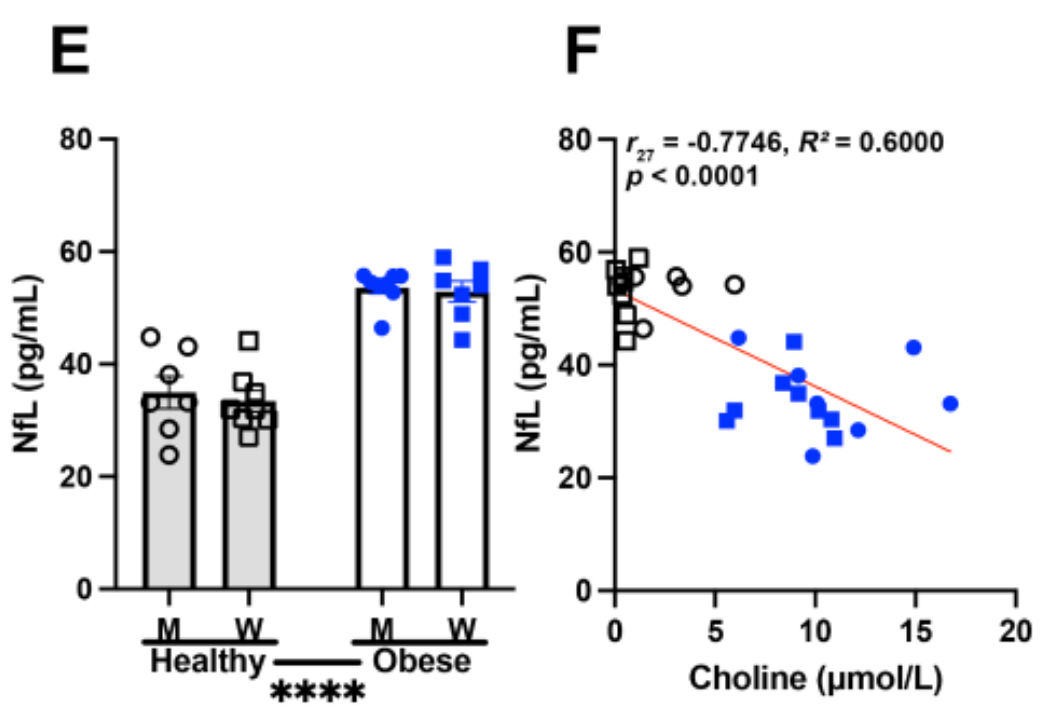
Remember, these participants were young, medically healthy adults. The fact that obese young participants had levels of a marker of neuronal death that were roughly comparable to those of much older adults suffering from mild cognitive impairment and Alzheimer’s disease, is frankly pretty terrifying.
Interestingly, the finding in this study that choline levels were lower in people with higher body fat contradicted two previous (and much larger) studies: Firstly, a cross-sectional analysis conducted in 421 Polish adults, found higher choline levels in obese individuals. And secondly, the POUNDS Lost Trial, which studied correlates of successful weight loss in 510 overweight and obese individuals, found that participants with the highest body fat percentage and visceral mass at enrolment had the highest baseline blood choline levels, and those whose choline dropped the most throughout the study, were the most likely to reduce body fat and weight. Clearly, more research is required to clarify the complex relationship between blood choline levels, obesity, metabolic dysfunction and cognitive decline.
But there’s already enough research to make one thing clear: carrying around excess body fat, particularly at a young age, is bad for your brain. If you want to optimise your cognitive function now, and reduce your future risk of developing dementia, attaining and maintaining a healthy level of body fat should be one of your highest priorities.
The good news
Fortunately, there is light at the end of the tunnel. Firstly, the researchers who carried out the brain blood flow study found that physical activity offset the harmful effect of obesity on cerebral perfusion (see graphic below).

And secondly, meticulous research conducted by Kevin Hall has shown that when overweight adults eat either an unprocessed diet or a low-fat, plant-based diet, but are permitted to eat as much as they desire, they spontaneously and unconsciously decrease their calorie intake.
The differences in calorie intake and weight loss are startling. Here’s a graphical summary of the results of the unprocessed diet on calorie intake and weight:

And here’s an illustration of the effects of a low-fat plant-based diet vs a low-carbohydrate animal-based diet on energy intake, enjoyment of food, desire to eat and fullness after eating:

To summarise, regular movement helps the brain receive sufficient blood flow while a low-fat wholefood plant-based diet allows people to reduce their energy intake without feeling hungry all the time. And while weight loss itself will reduce your dietary requirement for choline, there is abundant choline in protein-rich whole natural plant foods including legumes (especially soy beans and products made from them), cauliflower, broccoli and shiitake mushrooms.
So don’t lose hope, even if you’ve struggled with your weight for as long as you can remember. The science of obesity’s effects on the brain may be complex, but the solution to the problem is not.