Would you change your diet to reduce your dementia risk by 34%?
In over thirty years of clinical practice, I’ve had more conversations than I can remember with clients who were concerned that their protein intake was inadequate. My older female clients are particularly worried that they might not be “getting enough protein”, thanks to the relentless drumbeat of online nutrition content that emphasises the importance of protein for preventing age-associated sarcopenia (loss of muscle) and resultant frailty. (Although, as I demonstrated in a recent Deep Dive webinar for my EmpowerEd members, evidence from randomised controlled trials clearly shows that resistance training is the key to preserving and increasing muscle mass, with dietary protein playing a very minor role in augmenting the effects of such training.)
Yet I can’t recall a single instance in which a client presented with a concern that his or her fibre intake might not have been up to snuff. According to research presented at the 2026 annual meeting of the American Academy of Neurology, this neglect of fibre could have serious consequences for one’s risk of developing dementia.
The Rush Memory and Aging Project has been following up older people in the Chicago metropolitan area since 1997, seeking to identify factors involved in increasing and decreasing risk for problems with memory, mobility and strength in later life. Participants undergo annual blood tests and periodic imaging studies, complete dietary questionnaires, and agree to donate their brains and other biospecimens for postmortem analysis.
Researchers from Rush Medical School identified 1526 participants of the Memory and Aging Project, with an average age of 81, who were free of dementia at the time they completed their first dietary questionnaire. Over the next seven years, 28 per cent of them developed dementia. Analysing the dietary questionnaires, the researchers found that participants with the highest intake of dietary fibre at baseline – an average of 30 g per day – had a 34 per cent lower risk of developing dementia than those with the lowest intake – a measly 11 g per day – after adjusting for age, sex, education, BMI, physical activity, calories, and carriage of the ApoE-ε4 gene variant, which confers a higher risk of Alzheimer’s disease. The association between fibre intake and dementia risk persisted, after further adjustment for dietary intake of vitamin E, folate, omega-3, and lutein.
An intriguing finding emerged when the researchers teased out the impact of soluble vs insoluble fibre on dementia risk, on a subsample of 606 participants. Soluble fibre is readily fermentable by beneficial gut microbes, which synthesise – among many other goodies – the short chain fatty acid butyrate, which in turn stimulates production of brain-derived neurotrophic factor (BDNF). BDNF – the so-called ‘Miracle-Gro for the brain’ – stimulates the growth of new nerve cells and connections between existing ones, and low serum levels may be a risk factor for developing age-related memory impairment. Insoluble fibre, on the other hand, is poorly fermentable, and its primary function is to speed up the passage of waste material through the colon.
The researchers had hypothesised that a higher intake of soluble fibre would be associated with reduced risk of dementia, via its beneficial effects on inflammation and regulation of the gut-brain axis.
Surprisingly though, their analysis of participants’ dietary questionnaires revealed that it was insoluble fibre, not soluble fibre, that appeared to be protective against dementia. Participants with the highest intake of insoluble fibre had a 54 per cent lower incidence of dementia compared to those with the lowest intake, while there was no statistically significant association between soluble fibre intake and dementia risk.
What might account for this unexpected finding? I suggest that it relates to the subject of my previous post on nutritional dark matter. That is, it’s almost certainly the case that insoluble fibre is not in itself protective against dementia. Instead, it’s a marker for the consumption of foods that contain it – whole grains, legumes, nuts, seeds, and the skins of fruits and vegetables – and these foods reduce dementia risk via the actions and interactions of a myriad of nutrients, many of which have not been studied in any great detail, and some of which probably remain to be identified. Moreover, foods rich in insoluble fibre ‘crowd out’ foods that have been found to increase the risk of cognitive decline, such as processed meats and ultraprocessed foods.
This hypothesis is backed up by work done by another team of researchers, who analysed the dietary records of 926 initially dementia-free Rush Memory and Aging Project participants, followed for up to 20 years, through the lens of the Planetary Health Diet proposed by the EAT‐Lancet Commission. The Planetary Health Diet “largely consists of vegetables, fruits, whole grains, legumes, nuts, and unsaturated oils, includes a low to moderate amount of seafood and poultry, and includes no or a low quantity of red meat, processed meat, added sugar, refined grains, and starchy vegetables.” It might best be described as a wholefood plant-forward or flexitarian diet.
Participants whose diets most closely adhered to the Planetary Health Diet pattern had a 30 per cent lower risk of developing Alzheimer’s disease, and dementia from all causes. While the researchers did not calculate fibre consumption, the Planetary Health Diet is intrinsically high in total and insoluble fibre. As you can see from Table 1 below, those with the highest adherence to the Planetary Health Diet pattern ate considerably more fibre-rich whole grains, vegetables, fruits, nuts and legumes than those with the lowest adherence:
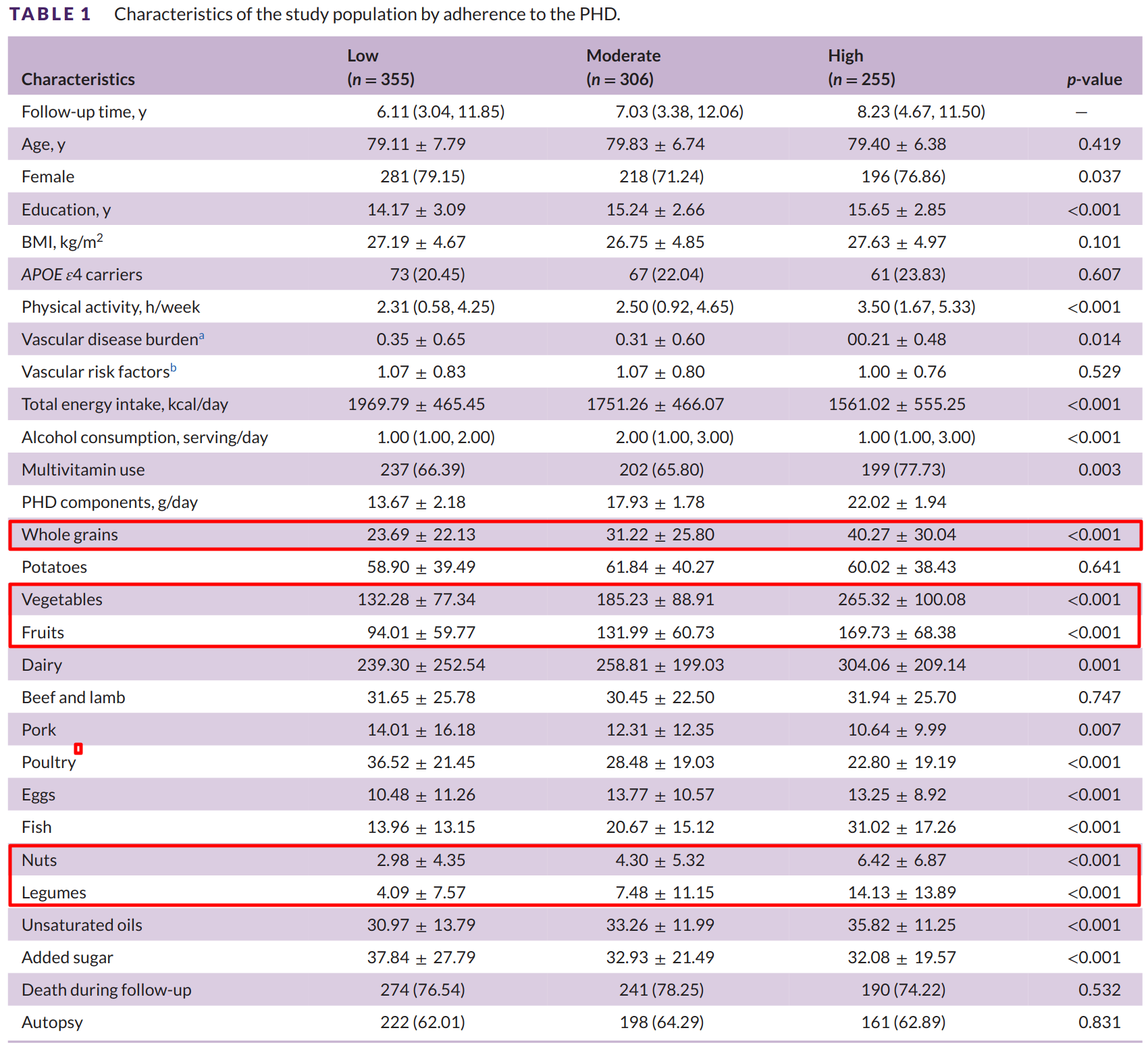
Abbreviations: APOE, apolipoprotein E; BMI, body mass index; PHD, Planetary Health Diet.
The number of subjects with missing values was 17 (1.84%) for BMI, 5 (0.54%) for APOE ε4, and 7 (0.76%) for alcohol consumption.
aVascular disease burden was calculated using self-reported data on four conditions: intermittent claudication, stroke, heart disease, and congestive heart failure.
bVascular risk factors were defined as the presence of hypertension, diabetes mellitus, and a history of smoking.
From ‘Association of the Planetary Health Diet with dementia risk and brain pathology‘.
How might one go about hitting the target of 30 g of fibre per day, which was associated with a 34 per cent lower risk of developing dementia? Honestly, it’s not hard at all. An older woman with a relatively small appetite could rack up almost 45 g of fibre by eating the following; men and active women could easily get to 60-70 g with larger serving sizes and extra fruits and vegetables.
| Food, quantity | Fibre, total (g) |
| Rolled oats (old fashioned), 1/4 cup | 2.0 |
| Ground flaxseed, 2 tbsp | 4.0 |
| Soy milk (unsweetened), 1/2 cup | 0.5 |
| Banana, 1 medium | 3.0 |
| Blueberries, 1/2 cup | 2.0 |
| Cos lettuce, shredded, 1 cup | 1.0 |
| Cherry tomatoes, 6 | 1.0 |
| Carrot, grated, 1/2 cup | 2.0 |
| 4 bean mix, drained, 1/3 x 420 g can | 4.2 |
| Quinoa, cooked, 1/2 cup | 3.0 |
| Tahini, 1 tbsp | 1.0 |
| Apple, 1 medium | 4.0 |
| Almonds, 30 g | 4.0 |
| Broccoli, steamed, 1/2 cup | 3.0 |
| Green beans, steamed, 1/2 cup | 2.0 |
| Pumpkin, steamed & mashed, 1 cup | 3.0 |
| Black bean burger patty, grilled | 4.0 |
| 43.7 g |
Finally, it’s worth noting that both higher fibre intake, and the Planetary Health Diet pattern, were protective against the development of dementia even in people with the high-risk ApoE-ε4 gene variant. I regularly talk to clients who have found out that they are at heightened risk of Alzheimer’s disease because they have one or two copies of this variant. It’s incredibly empowering for them to learn that they can mitigate this risk simply by making healthier dietary and lifestyle choices… including eating more fibre-rich whole plant foods.