German national skin cancer screening program fails to prevent people from dying of melanoma
Dear reader, can you believe that it’s been over four years since I filed an instalment in ‘I Informed You Thusly’? If you’re new around here, this is the miniseries in which I channel my urge to bellow “I TOLD YOU SO!!!!” at the top of my lungs, every time an article is published in a medical journal that admits that some crazy conspiracy theory I’ve been talking about for freakin’ years is actually true, into a (hopefully) more constructive direction.
(In case you missed it, Part 1, ‘Masks Don’t Work’, detailed the scientific evidence demonstrating that, well, masks don’t work when it comes to stopping or even reducing the transmission of respiratory viruses. Part 2, ‘Vaccine-induced Antibodies Don’t Confer Immunity Against Viruses that Replicate in Respiratory Mucosa – like influenza and SARS-CoV-2’, provided the evidence – straight from the pen of St Anthony Fauci himself – that vaccines don’t work to stop contraction or transmission of respiratory viruses like those that cause flu and flu-like illnesses, including COVID-19. And Part 3, ‘Molnupiravir causes transmissible mutations in SARS-CoV-2’ spilled the tea on evidence that molnupiravir, which is still approved in Australia as a ‘treatment of last resort’ for COVID-19, drives viral mutations that can be transmitted to other people, while not reducing either hospitalisations or deaths from COVID-19.)
Well, an article published in JAMA Dermatology spurred me to resurrect this series. ‘Population Skin Cancer Screening and Melanoma Mortality Rates‘ discussed the findings of an ecological (population-based) study which compared deaths from melanoma in Germany, which implemented a skin cancer screening program in 2008, with nine neighbouring countries that do not have skin cancer screening programs.
If you’ve read my previous articles, Skin cancer checks: life-saver or scam? and A quick update on skin cancer screening and melanoma incidence, you could probably have guessed the outcome, even without reading the subtitle of this article. But let’s have it straight from the horse’s mouth:
“In this comparative effectiveness study using population data from Germany and 9 neighboring countries, trends in age-standardized melanoma mortality rates between 2009 and 2022 in Germany were compared with those in neighboring countries without population-based screening for skin cancer. No statistically significant difference in the annual percentage change of melanoma mortality was found…
The findings of this ecological study are in line with previous studies that failed to show a melanoma mortality benefit associated with the German SCS [skin cancer screening] program.”
Population Skin Cancer Screening and Melanoma Mortality Rates
Translation: offering free skin cancer screening to the German population did not ‘save lives’ that would otherwise have been lost to melanoma. Wamp wamp.
Let’s dig into the details.
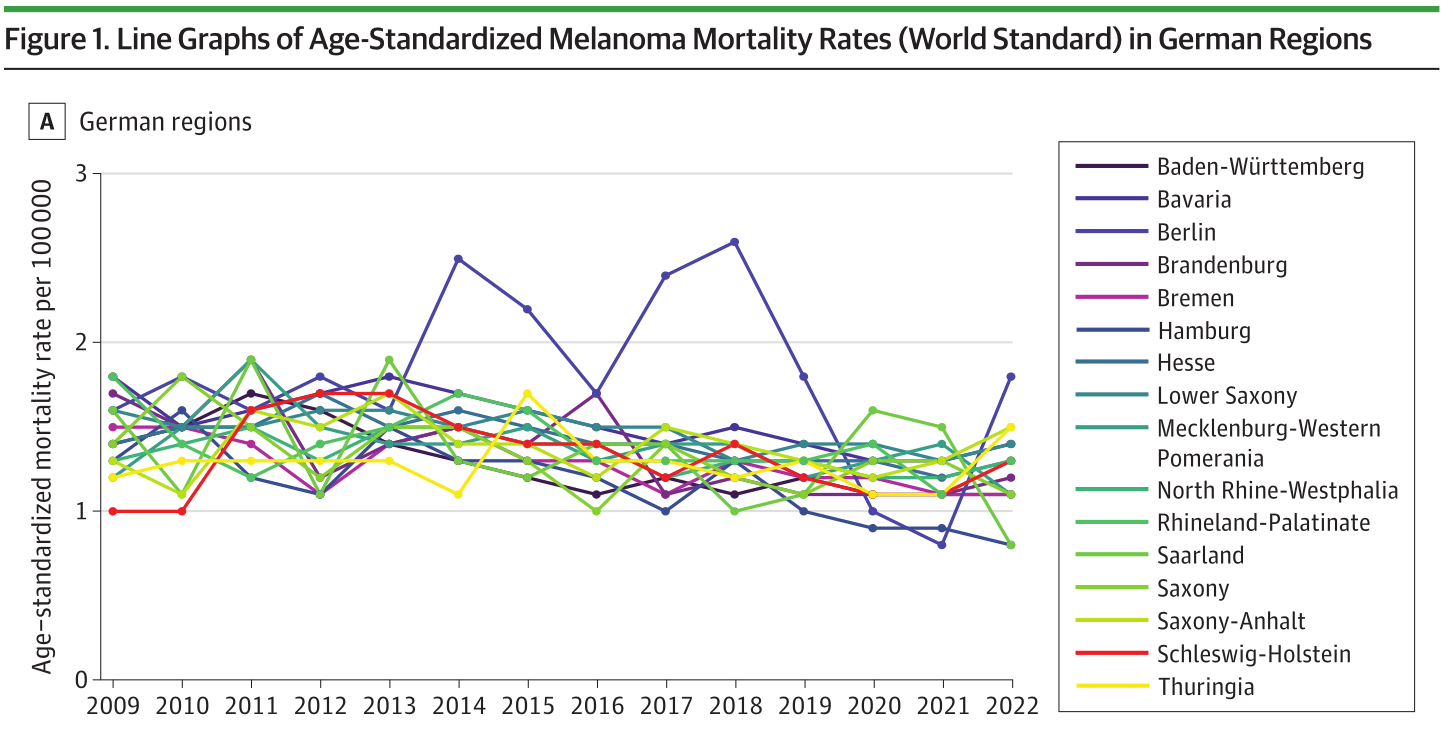
In January 2008, all Germans aged 35 years and older became entitled to receive a visual whole-body examination every two years. Roughly 32 per cent of eligible adults took up the offer. Between 2009 and 2022, the number of Germans who died from melanoma (per 100 000 of total population) declined, with mortality rates in the various states dropping, on average, between 0.1 and 3.8 per cent per year. Averaging across the entire German population, there was a -1.8 per cent annual percentage change in melanoma mortality between 2009 and 2022.
However, the average annual percentage change in melanoma mortality in nine neighbouring countries that have majority fair-skinned populations, just like Germany, but do not have skin cancer screening programs, was -2.2 per cent.
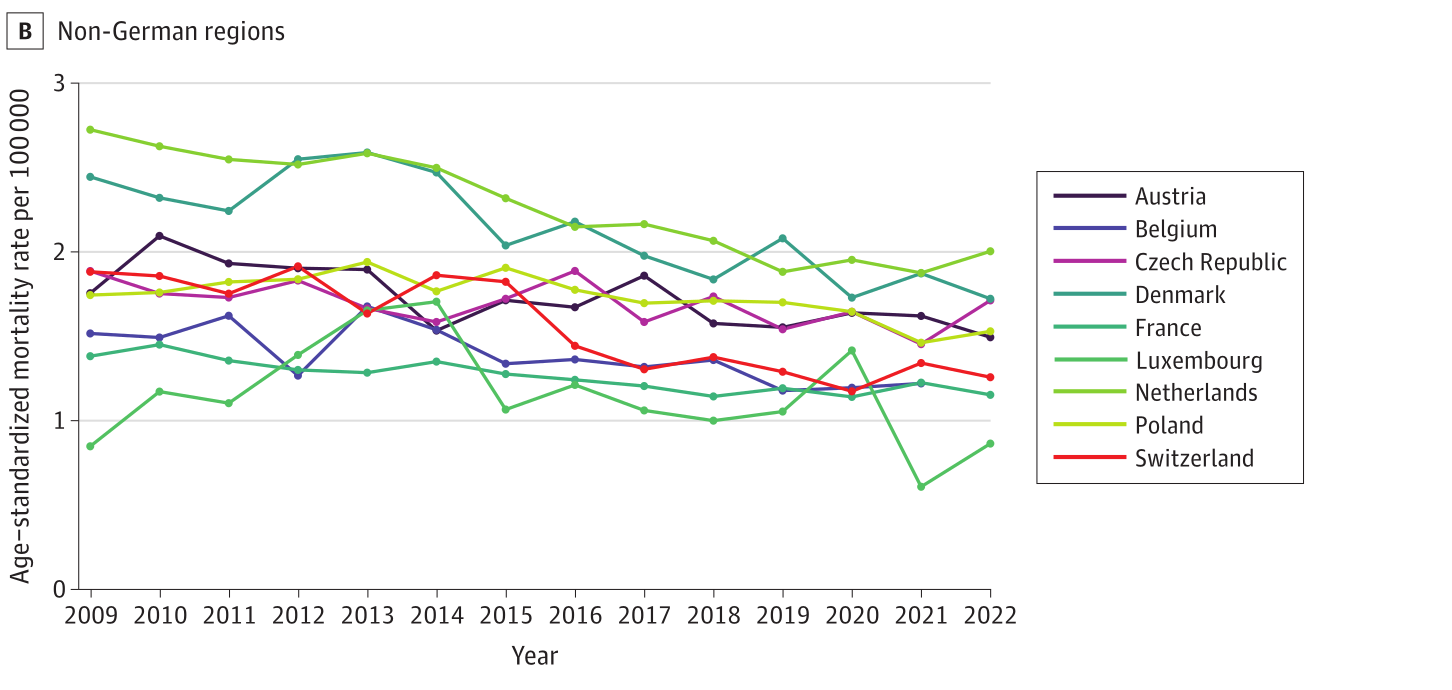
That is, the rate of decline in deaths due to melanoma was greater in countries that don’t have a screening program, than in Germany.
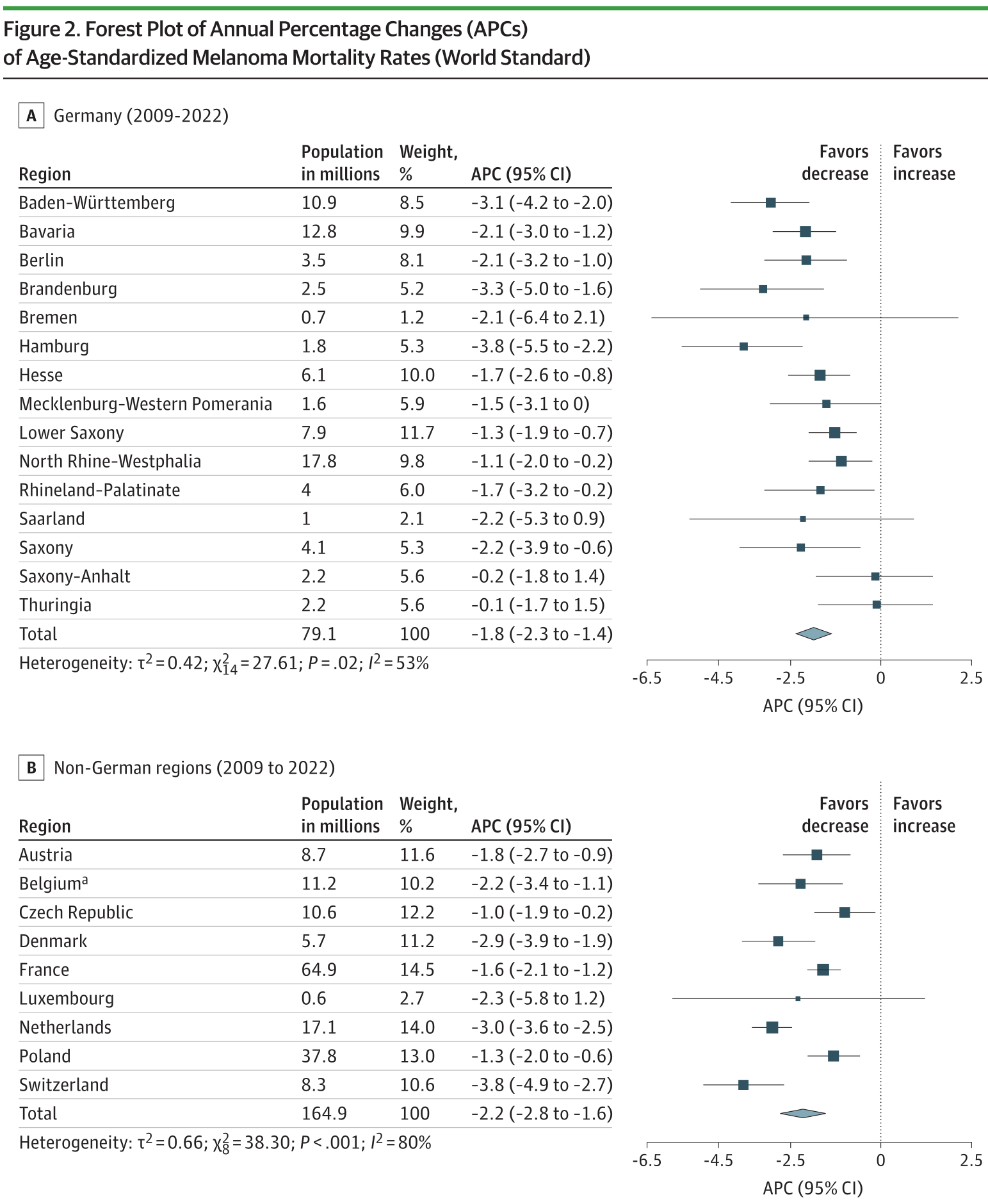
The difference in annual percentage change between Germany and its neighbouring countries did not reach statistical significance, meaning that it could have been a chance finding rather than evidence that Germany’s skin cancer screening program led to more people dying of melanoma than otherwise would have. But it’s certainly no endorsement for instituting a universal skin cancer screening program.
The authors stress that their ecological study design (i.e. comparing population-level data) is not as robust as a randomised controlled trial, and cannot be taken as proof that Germany’s skin cancer screening program has failed to reduce the risk of dying of melanoma. However, their results “are in line with previous studies that failed to show a melanoma mortality benefit associated with the current German SCS program”. Furthermore, only one study has found a benefit for skin cancer screening in the German population – a pilot program conducted in the northernmost state of Schleswig-Holstein – and these positive results may have been due to doctors misclassifying melanoma deaths as deaths due to “malignant neoplasms of ill-defined, secondary, and unspecified sites”.
Why did Germany’s nationwide skin cancer screening program fail to deliver a greater reduction in melanoma deaths than occurred in comparable countries with no screening program?
The authors pointed out that a Europe-wide ‘melanoma awareness’ campaign was launched during the years covered by their study. Higher rates of diagnosis of early-stage melanoma suggest that this campaign has been successful in prompting more people who live in countries that don’t have a population-wide screening program to seek skin checks. However, as I’ve pointed out previously, ‘catching melanoma early’ by identifying more early-stage lesions does not reduce the death rate from the disease.
They then raised the possibility that Germany may have lower rates of use of more effective treatments for melanoma (molecular and immune checkpoint therapies) than neighbouring countries, but once again, the evidence does not support this hypothesis.
Finally, they question whether doctors are adequately trained to carry out the visual scans, in the light of “a questionnaire-based study involving 204 general practitioners [which] found that most screening procedures failed to examine the complete skin”. In other words, the doctors failed to check all the sites where melanoma might occur, including the genitals and oral mucosa (inside the mouth).
The overdiagnosis trap
Unfortunately, the authors fail to acknowledge one of the potential contributing factors to the underwhelming performance of the national skin cancer screening program: overdiagnosis and its Siamese twin, overtreatment.
As I’ve written previously,
“Cancer screening results in considerable overdiagnosis – that is, many people are told that they ‘have cancer’, and undergo aggressive treatment which may lead to lifespan-shortening health problems (including, ironically enough, cancer), for a tumour which would never have led to serious illness or death if it had remained undetected.”
Major trial finds screening colonoscopy fails to ‘save lives’
Truth be told, a lot of what gets diagnosed as ‘cancer’ doesn’t actually require treatment, either because it’s indolent (slow-growing and unlikely to metastasise), likely to spontaneously regress, or because the patient is almost certainly going to die of something else, before the cancer can manage to do them in. I find that most people are really resistant to the idea that in many – and perhaps even most – cases of screen-detected cancer and so-called incidentalomas (cancers that are accidentally found while testing for something else), you would have been better off not knowing that you ‘have cancer’ because once you get that diagnosis, you’re going to be cattle-prodded down a path of further testing, treatment and follow-up that will compromise your physical health and psychological well-being.
As extraordinary as it may seem, cancer screening has never been shown to “save lives”. Let me repeat that, for those of you who are snoozing in the back row: Cancer screening has never been shown to “save lives”. As I wrote previously,
“Some, but by no means all, randomised controlled trials of cancer screening have found that people who undergo screening are less likely to die from that particular cancer. However, many of the same studies found that overall mortality was higher in the screened group.”
Major trial finds screening colonoscopy fails to ‘save lives’
Don’t take this to mean that you’re helpless in the face of cancer; in fact, you have enormous power to reduce your risk of developing cancer, and dying from it, by adopting some pretty darn basic healthy lifestyle habits, like eating fruits and vegetables every day, getting regular exercise, and laying off the booze and ciggies. In fact, you’d be far better off investing your time, money and effort into enrolling in a healthy cooking course and a gym or tennis club membership, than participating in screening programs that probably won’t benefit you, and may in fact harm you.
Final note
As emphasised in my previous articles on overdiagnosis of cancer, screening is not the same as diagnosis. If you notice a skin lesion that is rapidly growing, changing colour, causing you pain or irritation, or behaving in any other fashion that causes you concern, get it checked by a competent doctor – preferably one who doesn’t make a sizeable chunk of their income from diagnosing and treating such lesions.