2 June 2025
Last week’s post on the African diet swap study got me thinking about the mechanisms by which rapid changes in body function – such as inflammatory and metabolic activity – can occur, in response to a change in diet. The authors of the study themselves speculated that diet-induced changes in gut microbiome might be part of the explanation (and in fact, they will be publishing their findings on the effect of the diet swaps on participants’ gut microbiomes, in a subsequent paper).
And that brought to mind a 2019 paper by the husband-and-wife team of gut microbiome researchers, Erica and Justin Sonnenburg, on the diverging evolutionary trajectories of humans, and our microbiome. The article, titled ‘The ancestral and industrialized gut microbiota and implications for human health’, published in the journal Nature Reviews Microbiology, argues that the epidemic of chronic diet- and lifestyle-related illness that is engulfing 21st century humans is both the result of a mismatch between the speed of evolutionary adaption of the human genome versus our resident microbiota’s genome; and an evolutionary force in itself that may eventually select for individuals whose genes are resistant to the disease-inducing elements of the industrialised diet and lifestyle.
Our human genome – dependent on vertical transmission of genes from parent to offspring – evolves slowly, only capable of adapting to shifts in the environment over the course of decades to centuries. The mainstream Darwinian model of evolution holds that adaptation occurs when a gene or ensemble of genes, acquired at conception, happens to confer a particular survival and reproductive advantage upon the offspring in the particular environment in which it finds itself. Such selection events can only occur once in a generation – that is, approximately every 20 years.
This leisurely tempo of evolution is well suited to a slow-paced change in environment or lifestyle, such as the gradual diaspora of humans out from Africa, where our species is believed to have evolved, into Asia and beyond. For example, as our ancestors migrated from equatorial regions into higher latitudes, individuals with mutations resulting in paler skin would have had a survival and reproductive advantage over their dark-skinned peers, because they could produce more vitamin D from reduced or intermittent sun exposure. If two individuals with this mutation mated, their children would have even fairer skin and greater survival and reproductive chances, allowing them to push even further north without suffering from vitamin D deficiency. Over centuries and then millennia, the trait of fair skin came to dominate groups of people who lived in northern latitudes… as is readily apparent when you visit Scandinavian countries!
But our resident microbes have far fewer constraints on their adaptation. Firstly, they replicate much more rapidly than us, doubling every 20 to 30 minutes in ideal conditions, which allows for far more frequent occurrence of chance mutations that confer survival advantages. Secondly, they are capable of horizontal gene transfer – that is, one bacterium can pass DNA that confers an adaptive trait directly to another bacterium, either of its own species, or another species altogether. Consequently, bacteria and certain other single-celled organisms can adapt far more rapidly to shifts in environmental conditions such as changes in temperature, pH and nutrient availability than humans.
For millennia, this metabolic flexibility of our resident microbes played to our advantage. We harnessed their fast rate of adaptation to compensate for our relatively slow rate – especially when it came to nutrition. The foraging lifestyle of our ancient ancestors presented them with dramatic fluctuations in the availability of particular foods. Each species of fruit, nut and seed ripened only in certain seasons; hunting had fairly low success rates1 resulting in highly variable intake of very lean meat to supplement the dietary staple of extremely high-fibre starchy plant foods such as tubers2. The ability of our gut microbiota to adapt to such a diverse and ever-changing range of foodstuffs was crucial to our survival.
Within hours of a novel food arriving in our gastrointestinal tract, bacteria with the capability of utilising it start to replicate. In human experiments, abrupt changes in dietary intake result in rapid shifts in the composition and metabolic activity of our gut microbiota. These same shifts have been observed in contemporary foragers like the Hadza, in response to seasonal changes in food availability:
“Recent evidence in the Hadza hunter-gatherers hints at the loss of seasonal dynamics within the industrialized microbiota. The Hadza microbiota displays a pattern of cycling that corresponds with the seasonal nature of their diet. Interestingly, the taxa that become undetectable and then re-emerge each year are those that are rare or absent in industrialized microbiotas.”
The ancestral and industrialized gut microbiota and implications for human health
In a nutshell, industrialisation of our food supply has wrought changes in our diets never before seen in human history:
Firstly, the industrialised, or Western, diet is characterised by high intake of ultraprocessed foods that are deficient in what the Sonnenburgs dub microbiota-accessible carbohydrates, or MACs – that is, types of carbohydrate that evade human digestive processes, and hence are available to colonic bacteria as an energy source. Comparisons between the gut microbial composition of (apparently) healthy Westerners vs people following traditional foraging or rural agricultural lifestyles underline the central importance of MACs to the ancestral microbiome:
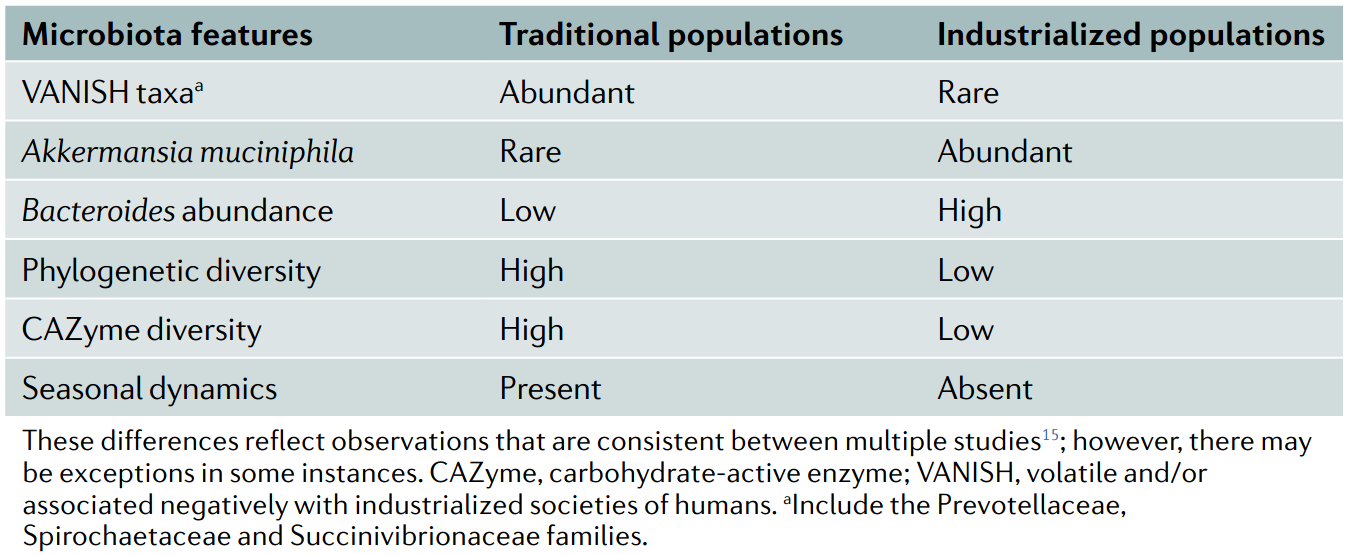
“Most traditional populations harbour a microbiota with greater overall phylogenetic and carbohydrate-active enzyme (CAZyme)
The ancestral and industrialized gut microbiota and implications for human health
diversity than Western populations.”
Secondly, the industrialised diet prominently features animal products that are substantially higher in total fat and most especially saturated fat than the wild animals eaten by our ancestors, resulting in proliferation of bile-tolerant microorganisms that promote inflammation and cancer formation.
And finally, dramatic reduction in the diversity of our food supply has resulted in significant declines in microbiota diversity and loss of entire taxa (genetically-related groups of bacteria) in urban humans compared to those living in rural settings, and even more so when compared to the few remaining populations of foragers:
Compounding the loss of species diversity are the overuse of antibiotics, both as prescribed drugs and as feed additives to farmed animals; widespread use of antibacterial products in homes, workplaces and hospitals; caesarean section births and insufficient breastfeeding.
The Sonnenburgs hypothesise that the rapid changes in diet and lifestyle engendered by industrialisation have uncoupled the previously harmonious relationship between humans and our microscopic inhabitants, largely because of the wildly divergent capacity of each to adapt to environmental flux. That is, we are now faced with a situation in which our resident microflora have adapted to the modern environment, but for the first time in our long co-evolution with these microbes, their adaptations are detrimental to our health.
For example, the Sonnenburgs point to the dominance of members of the Bacteroides genus (see Table 1, above) and the depletion and even loss of Prevotellaceae, Spirochaetaceae and Succinivibrionaceae families in the microbiotas of Westernised populations compared to foragers:
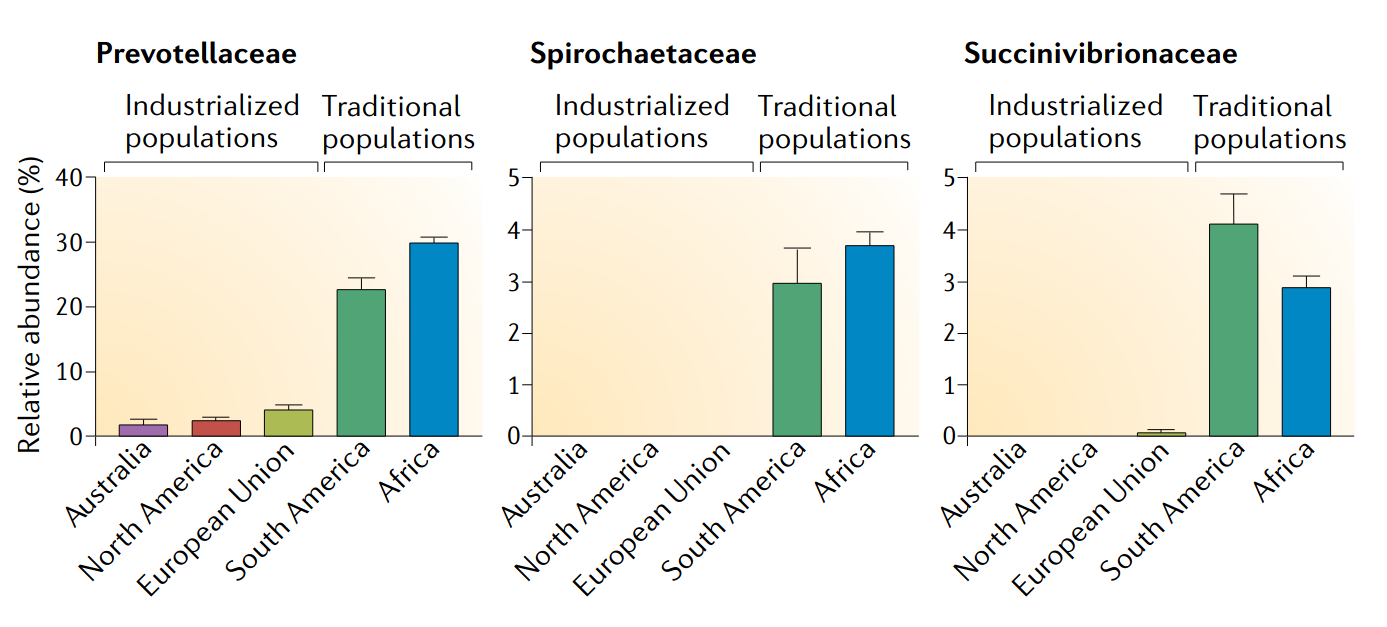
VANISH (volatile and/or associated negatively with industrialized societies of humans) taxa
(Prevotellaceae, Spirochaetaceae and Succinivibrionaceae families) in the gut microbiota of individ-
uals from industrialized societies in Australia (n = 63), North America (n = 709) and the European Union
(n = 408) and from traditional populations in South America (n = 161) and Africa (n = 997). These VANISH
taxa comprise approximately one-third of the gut microbiota from traditional populations but only
~3% of that from industrialized populations. Error bars denote s.e.m. From The ancestral and industrialized gut microbiota and implications for human health.
This dysbiotic pattern – high Bacteroides, low VANISH taxa – is linked with increased inflammatory activity, which in turn is the driving force behind all chronic lifestyle diseases including coronary artery disease, type 2 diabetes, autoimmune conditions and cancer – conditions that are notably absent among forager populations, even in the elderly, but are the major causes of disability and premature death in industrialised countries.
While Bacteroides species thrive on a diet high in fat and protein, the other three bacterial groupings are adapted to live off the types of carbohydrates found in unprocessed plant foods. Remove such foods from our diet, and we lose the bacteria that feed on them. We have been cohabiting with these bacteria for hundreds of thousands of years, with mutual interaction between our genome and theirs. The Sonnenburgs propose that the loss of bacterial signalling may be contributing to the dramatic increase in autoimmune disease, metabolic dysfunction and neurodegenerative disease observed in every industrialised country over the last few decades:
“We propose the term microbiota insufficiency syndrome (MIS) to describe the loss of microbial taxa and associated functions that were part of our evolutionary past in individuals in the industrialized world. It is our opinion that aspects of our microbial identity have gone extinct and that this extinction results in a mismatch between our recently adapted microbiota and our more slowly adapting
The ancestral and industrialized gut microbiota and implications for human health
human genome13,16. Molecular signals (for example, metabolites or molecular patterns) provided by microbial taxa that are no longer present in the industrialized microbiota, but were historically part of human biology, are likely to have shaped aspects of the genome (for example, coding for receptors, signalling pathways or regulatory elements) over the course of evolution. Loss of these microbial signals, ‘expected’ (in an evolutionary sense) by the human genome, could result in misregulation of important systems, including immune function, metabolism and central nervous system function. The increase in capacity to degrade host mucus, among other changes in the industrialized microbiota, may result in maladaptive responses from the host, such as inflammation. These changes could be a causative or contributing factor to the many non-communicable chronic diseases (NCCDs) presently rising in industrialized societies, such as cardiovascular diseases, diabetes, cancer and chronic respiratory diseases, many of which are partially or entirely driven by a misregulated immune system.”
Furthermore, we are dependent on byproducts of microbial fermentation such as short chain fatty acids (including butyrate, propionate and acetate) for a host of functions, including fuelling the cells that line our colons, regulating muscle contraction throughout our intestines, optimising insulin activity, and even regulating production of brain-derived neurotrophic factor, which prompts the birth of new neurons (brain cells) and increased connectivity between existing neurons. Depletion of bacteria that produce vital compounds such as butyrate is implicated in numerous chronic illnesses including Crohn’s disease, type 2 diabetes and colorectal cancer.
Eventually, the Sonnenburgs suggest, individuals whose genes make them particularly susceptible to pathological interactions between Western diet and lifestyle patterns and the ‘industrialised’ gut microbiota may be selected out of the gene pool due to shortened lifespan and diminished reproductive capacity; such is the nature of evolutionary pressure. ‘Survival of the fittest’ refers to being the best fit for one’s environment; in a toxic environment, ‘fitness’ means being able to withstand that toxicity without succumbing to disease for the longest possible time.
But what about those who are least ‘fit’ for the industrialised diet and lifestyle and its resultant microbiome, and who, therefore,are currently manifesting this evolutionary mismatch in the form of chronic illnesses such as types 2 diabetes, inflammatory bowel disease and atherosclerotic heart disease?
The Sonnenburgs propose ‘rewilding’ our depleted microbiota by dramatically curtailing our use of antibiotics and antibacterial products; adding MACs from unprocessed plant foods back into our diet; and perhaps even deliberately reintroducing lost species of bacteria, via faecal microbial transplantation, from populations of humans who still retain them due to traditional diet and lifestyle practices.
In the 2008 Pixar film WALL-E, 29th century humans are depicted as helpless, indolent, obese creatures. Generations of exposure to microgravity aboard giant spaceships furnished by the Buy n Large megacorporation (which played a large part in despoiling the Earth their ancestors fled), and total reliance on machines to service their every need, have acted as evolutionary selection pressures. With no requirement to think for themselves, navigate adversity or perform any actions on their own behalf, both the bodies and minds of these future humans have been weakened. Only a return to self-reliance on Earth (depicted in the movie credits, as they re-learn to move their flabby bodies and grow their own food) can restore their physical and psychological well-being by presenting them with a healthy level of challenge.
Just like the ‘rewilding’ of 29th century humans depicted at the end of WALL-E, the restoration of the health of 21st century humans may depend on us being willing to accept some key challenges: not resorting to caesarean sections and formula feeding unless there is literally no alternative that preserves the health of mother and baby; reviving traditional knowledge about how to nurse ourselves and our children through non-life-threatening infections rather than begging the doctor for an antibiotic to treat every sniffle; reacquainting ourselves with the joys of growing our own food, even if it’s just a pot of herbs or tray of sprouts on the kitchen windowsill; and restoring the lost art of preparing high-MAC foods such as legumes and whole grains from scratch, rather than microwaving a box of industrial goop or ordering Uber Eats.
Let’s hope we can rise to the challenge sooner rather than later.
Struggling with chronic disease? Need help to get your health back on track? Apply for a Roadmap to Optimal Health Consultation today.
- Ethnoarchaeologists infer hunting success rates in paleolithic people, from observations of extant hunter gatherer populations. Two of the few remaining such populations are the Hadza of Tanzania and the !Kung people of southern Africa. Both groups use the bow and arrow – a fairly recent innovation (first appearing in primitive form around 71 000 years ago, i.e. late in the Paleolithic period that began around 3.3 million years ago and ended about 11 700 years ago) that dramatically increased hunting success rates. Despite the presumptively significantly greater hunting efficiency of contemporary foragers compared to paleolithic peoples, nonetheless, “Hadza success rates of about one large carcass per hunter per month were four to six-fold higher than the !Kung hunter success rates reported by Lee (1979:242). ‘During the 83 hunter-days covered by his 1964 !Kung work diaries, no large antelope were taken. Only 4 of the 18 prey captured during that period weighed more than 10 kg (p. 266), and those were warthogs taken by the best hunter using his “excellent dogs”’ (Hawkes, O’Connell and Blurton Jones 2001b: 687).” ↩︎
- Underground storage organs (USOs, i.e. tubers, corms and bulbs) are a little-discussed but extremely important component of our ancestral diets: “The use of USOs by most tropical foragers implies they were probably part of the diet at least since the appearance of modern humans.” In fact, these starchy plant foods are believed to have played a key role in the evolution of anatomically-modern humans, including the development of our large brains which are heavily dependent on a constant supply of glucose. ↩︎