In a previous post, Hormonal contraception and women’s mental health, I discussed the findings of a study that tracked over 1 million Danish women aged 15-34 for 14 years, and found a dramatically increased risk of being diagnosed with depression in adolescents (aged 15-19) who were using hormonal contraceptives.
Now, a new study has extended on the Danish research, uncovering a link between commencing use of oral contraceptives in the teenage years, and increased vulnerability to depression over the long term.
The study used data extracted from the United States National Health and Nutrition Examination Survey (NHANES), and identified 1236 women for whom information on depression and age at first use of oral contraceptives was available.
They found that women who had never used oral contraceptives had only 0.31 times the odds of suffering major depression as women who had used the Pill during adolescence, while women who only started using oral contraceptives in adulthood had 0.54 times the odds of major depression as those who took it in their teens.
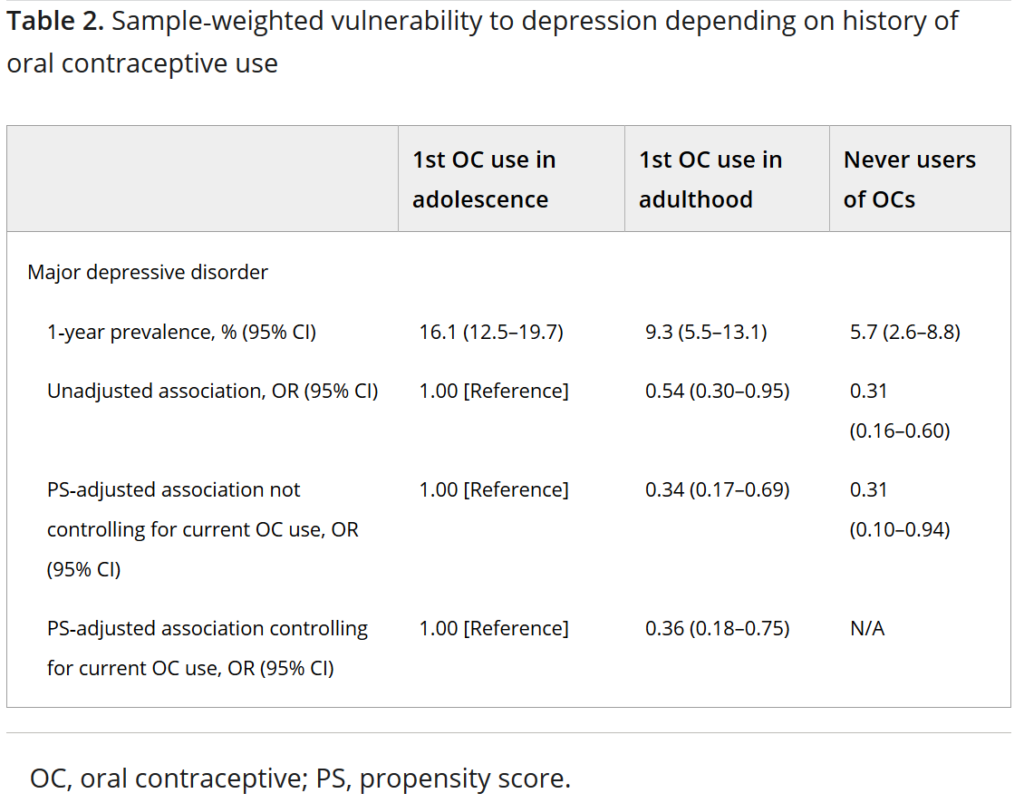
The researchers noted two other factors that have previously been proposed to explain the observed relationship between oral contraceptive use in one’s teens, and experiencing depression as an adult.
The first is having had your first sexual encounter at a young age, which is potentially an indicator of psychosocial factors such as low self-esteem or distant relationships with your parents, that may predispose to depression.
The second is current use of oral contraceptives, which is an acknowledged risk factor for experiencing depression.
However, after applying statistical techniques to factor out these two potential confounders, the association between using the Pill in one’s teens and the risk of developing major depression in adulthood persisted.
The researchers propose that
“Adolescence may represent a sensitive period during which the use of OCs [oral contraceptives] could increase women’s likelihood to develop depression until years after first exposure. This interpretation is in accordance with the abundant evidence from animal models showing that gonadal hormones can cause long‐lasting changes in brain and behaviour especially during critical developmental periods such as puberty/adolescence.”
Or in plain language, taking the Pill as a teenager may cause changes to the way your brain forms and functions, making you more prone to depression, possibly for the rest of your life, even if you stop taking it.
If this theory is correct, the implications are extremely concerning. The researchers note that over half of sexually active US women aged 15–19 years currently use oral contraceptives; accurate and up-to-date Australian figures are hard to come by, but my clinical experience suggests that the situation here is similar to the US.
However, one in three teenage girls use the Pill solely for noncontraceptive purposes, such as reducing menstrual cramps and blood flow, regulating their cycle (including skipping periods when they’re travelling) and to control acne.
I vividly remember my own visit to the GP, at age 18, in which I shared that my menstrual cycle had become wildly irregular since my HSC year.
Without inquiring about my mental health (I was completely shattered from the stress of that annus horribilis to which NSW teens are subjected), she blithely prescribed the Pill “to regulate your periods”, as she put it.
After a couple of years of putting up with premenstrual bloating and mood swings, I decided to stop taking the Pill… only to discover that it had been masking an underlying hormonal imbalance that took several years of detective work to uncover and correct.
In the mean time, I lost bone density in my lumbar spine and hip due to prolonged amenorrhoea (absence of menstrual periods), not to mention the anxiety that I harboured about my future prospects of becoming a mother.
In the face of the epidemic of mental health issues in younger people, it seems inexplicable to me that teenage girls are still being prescribed the Pill at such high rates, and in particular for health issues that could easily be dealt with through non-pharmaceutical means, and with scant regard for the impact of this powerful medication on current and future risk of depression.
Unwanted teenage pregnancy is without doubt a potentially catastrophic life event that we should be doing everything in our collective power to prevent, but we shouldn’t be throwing adolescents’ current and future mental health under the bus in order to do so. Our girls deserve better.