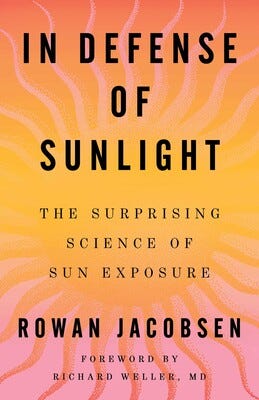
Following on from my interview with John MacMahon, I had the great pleasure and privilege of speaking with Rowan Jacobsen, author of the soon-to-be-published book In Defense of Sunlight. (Visit the book publisher’s [Simon & Schuster] international page here and Australian page here.)
The book is a labour of love for Rowan, who spent several years digging deep into the science of the manifold benefits of sunlight exposure for human health and well-being. Along the way, he interviewed many of the top researchers in this fascinating and surprisingly controversial field. Why is it controversial to study the beneficial effects of sunlight exposure? Because (as with so many other domains of medical science) doctors and public health authorities have been reluctant to admit that the simple, one-size-fits-all message that has been promulgated since the 1980s – that any sun exposure is bad for you – is wrong-headed, and may have inadvertently contributed to the burden of chronic illnesses including diabetes, cardiovascular disease and many types of cancer.
Our conversation ranged over many topics, from the heliotherapy movement of the early 20th century, to the paradox of increasing melanoma incidence in countries with strong public health messaging around sun avoidance, to the notion of sunlight exposure as a hormetic stress, which increases the efficiency of repair mechanisms as long as it’s not overdone.
Rowan referred to the following papers, position statements and individuals:
- Australian Skin and Skin Cancer Research Centre Position Statement: Balancing the Harms and Benefits of Sun Exposure.
- Professor Richard Weller: the Scottish dermatologist who was the first person to document nitric oxide production in the skin from sunlight exposure, with knock-on effects including reduction in blood pressure. Weller coauthored Higher ultraviolet light exposure is associated with lower mortality: An analysis of data from the UK biobank cohort study, which found that people with higher UV exposure had lower all-cause, cardiovascular disease (CVD) and cancer mortality.
- Reduced Melanoma After Regular Sunscreen Use: Randomized Trial Follow-Up – the Nambour study which found a statistically non-significant reduction in melanoma incidence in people who used SPF 15+ sunscreen daily vs those who used sunscreen on a discretionary basis.
I’ve written a number of posts that touch on the vital importance for health of sensible sunlight exposure, including The vitamin D-ilemma Part 5, Skin cancer checks: life-saver or scam?, and The good news about depression – Part 3.
I wholeheartedly encourage you to pre-order Rowan’s meticulously-researched and thoroughly engaging book, In Defense of Sunlight,read it cover-to-cover, and follow his sage advice to “Get sun. Not too much. Go outside.”