
Research on human perception of skin colour sheds light on the ‘diet wars’
31 March 2024
The post-COVID epistemic crisis: “I don’t believe anything the ‘experts’ tell me anymore”
Among the many persistent after-effects of the COVID operation is that a small but significant proportion of the population has completely lost trust in all social and political institutions, including the scientific research enterprise. I totally understand this phenomenon as I’ve experienced it myself, in spades.
I thought I was appropriately cynical about politicians before the scamdemic, but I no longer believe that governments have any interest whatsoever in protecting and promoting the interests of their citizens; it’s abundantly clear that they serve other masters. I no longer believe that regulators like the Therapeutic Goods Administration (TGA) or the Australian Health Practitioner Regulation Agency (AHPRA) exist to protect people against the unscrupulous behaviour of drug companies or rogue practitioners; the TGA shills for the industry that provides 96 per cent of its budget, while AHPRA ruthlessly punishes doctors who attempt to fulfill their Hippocratic oath by practising patient-centred care but turns a blind eye to those who sexually abuse their patients.
I never believed that the ‘War on Drugs’ or the ‘War on Terror’ were legitimate enterprises, but now I know for sure that the drug trade is, and always was, controlled and managed by intelligence agencies and the real terrorists are our governments (or the powers behind them). I used to believe that anthropogenic climate change was a serious concern, but then I found out that the atmospheric carbon dioxide concentration is near its lowest point in the last 140 million years.
And so on and on it goes, from the Shakespeare authorship debate to the real reason that World War One was launched to the moon landing controversy. Everything I thought I knew, everything that I believed was true without ever examining its evidentiary basis, is now in the ‘not-sure-about-that-until-I’ve-subjected-it-to-rigorous-evaluation’ category.
In many ways, this is a good thing. We shouldn’t believe everything that ‘authorities’ and ‘experts’ tell us, without investing at least some effort to investigate matters for ourselves. But who has the time to undertake a detailed study of every claim that’s made by every politician, economist, historian, doctor, scientist, and any other damn Tom, Dick or Harriet who – often for reasons we don’t understand – is granted their turn in the bully pulpit? And who has the background knowledge of each field that’s required to make sense of all the conflicting claims? I certainly don’t.
Warhol’s revenge: Everyone will have their 15 minutes of internet experthood
An epistemic crisis1 was already simmering before the scamdemic was launched on a largely unsuspecting public, as many people were becoming increasingly convinced that they had no shared reality whatsoever with people with opposing political alignments and social mores. (How do you have a conversation with someone who insists that a man can become a woman???) This crisis was fuelled to boiling point by the brutal attacks on civil liberties, property rights and medical ethics which were framed by ‘the experts’ as ‘public health interventions’, and it has spawned an information landscape in which any internet rando can build a loyal audience among the disillusioned segment of the population by arguing that their opinions on subjects that they have no formal qualifications in, should be listened to precisely because they’re not one of those discredited ‘experts’.
In my field – human nutrition and health – this has led to an explosion of self-appointed ‘influencers’ who trade on the trope that everything the experts tell you about nutrition is wrong, but I have the truth that’s been hidden from you. The so-called health freedom movement is riddled with newly-minted celebrities who espouse extreme fads such as the carnivore diet, and the even more restrictive ‘lion diet’. Every day, I’m forwarded emails and videos from famous-within-certain-circles doctors who hyperventilate about the catastrophic consequences of eating fruit, vegetables, legumes and whole grains, and exhort me to chow down on beef tallow and organ meats instead. Even a cursory reading or viewing of their content reveals an ignorance of human physiology and biochemistry that is so breathtakingly comprehensive that I would find it hilarious, if it weren’t for the fact that many of their readers and viewers actually take their proclamations deadly seriously.
I hate to break it to you, folks, but speaking out on the COVID nonsense doesn’t make a doctor an authority on human nutrition, any more than it made me an instant expert on brain surgery. While I’m fully aware of the iniquities of academic gatekeeping (exemplified by the regime scientists’ constant hectoring of COVID dissidents to ‘stay in their own lane’), it’s a simple reality that each field of human knowledge rests on a foundation of fundamental facts, and if you do not know these facts, you are at risk of being snowed by arguments that depend on your ignorance of them.
For example, if you don’t know that lectins are small, carbohydrate-binding proteins produced by both animals and plants that are ”ubiquitous in living organisms”, and that many lectins from plant foods have well-established health benefits, you might be suckered into adopting a (purportedly) low-lectin diet and shelling out your hard-earned cash to buy a totally non-evidence-based supplement to ‘protect’ you from accidental exposure to these imaginary nutritional hobgoblins.
And if you don’t know that phytate has anti-inflammatory, anti-cancer and bone-building activity, you might fall for the completely erroneous argument that phytate is an ‘antinutrient’ which will prevent you from absorbing vital minerals, and hence be persuaded that you should eliminate high-phytate foods such as whole grains and legumes from your diet.
And if you are unaware that every cell in your body can and does synthesise all the cholesterol that it needs, from either glucose or fatty acids, and that the brain makes its own cholesterol and doesn’t absorb it from the general circulation, you’re at risk of being taken in by the utterly fallacious notions that you need to eat cholesterol-rich foods, and that having a lower serum cholesterol level puts you at increased risk of cancer, premature death and dementia.
“Nothing in biology makes sense except in the light of evolution.”
Theodosius Dobzhansky
I find it particularly offensive when the self-appointed experts who evidently don’t know jack sh*t about human physiology or nutritional biochemistry, invoke evolution to justify their extreme dietary recommendations. (Yes, I know that many people dispute the validity of evolutionary theory too, but I find that upon closer questioning, they have a caricaturish conception of evolution and no grasp whatsoever of the five mechanisms of evolution – non-random mating, gene flow, finite population size [genetic drift], mutation and natural selection. If you still don’t ‘believe in evolution’, ask yourself how humans bred every variety of dog, from chihuahuas to Great Danes, from a wolf ancestor, or why Ashkenazi Jews are plagued with genetic diseases. Both phenomena reflect evolutionary processes.)
I feel like screaming every time I hear one of these jackass doctors insisting that meat-based diets promote health because ‘meat made us human’. This longstanding trope was discredited by a 2022 comprehensive analysis of the archaeological evidence for meat eating which found “no sustained increase in the relative amount of evidence for carnivory after the appearance of H[omo] erectus, calling into question the primacy of carnivory in shaping its evolutionary history”. In other words, eating large quantities of meat did not drive evolutionary changes in our early ancestors, because they weren’t eating any more meat than the species that preceded them. In particular, adding meat to the plant-centred diet of our primate ancestors was not responsible for the prodigious growth in brain size that characterises the human lineage.
Instead, the high glucose availability required for the development of humans’ large brains could only be met after our ancestors began processing and cooking tubers and other starchy foods, a behavioural adaptation which, according to analysis of hominid vs nonhuman primate oral microbiomes, occurred before the Neanderthal and modern human lineages diverged, more than 600 000 years ago.
Colour me healthy
Starch is not the only component of plant foods that has played a key role in shaping human evolution. There’s a fascinating body of evidence indicating that people of diverse ethnicities have highly sensitive mechanisms for detecting the level of intake of carotenoids in others, and they perceive people who manifest higher carotenoid consumption as being healthier than those with low intake. Carotenoids are yellow, orange and red pigments found primarily in plants such as sweet potatoes, carrots, pumpkin, rockmelon (cantaloupe), spinach, kale, tomatoes, and capsicum (bell peppers).
Many years ago, I wrote a post called Beautifully Healthy, in which I summarised a 2011 study which found that
- People who eat more fruits and vegetables (and hence, have a higher carotenoid intake) have significantly more yellow tones in their facial skin.
- When showed photographs of people with a variety of skin tones (pale, sun-tanned, carotenoid-yellow) both white Britons and black South Africans found the people with the most carotenoid-hued skin, the most healthy-looking.
- When instructed to use a computer program which allowed them to manipulate the skin tones of people in photographs, with the aim of making them look as healthy as possible, most participants chose to increase the carotenoid (yellowish) tones, rather than make the skin appear more tanned.
I recalled this study when I was preparing for a webinar on Holistic Skin Care for my EmpowerEd membership group (which you can watch by signing up for a free 1 month trial, here). I then discovered that the lead author, Ian Stephens, had produced a slew of papers on the role of carotenoid pigmentation in perceptions of human health. He even wrote his PhD thesis on the topic, with a particular emphasis on sexual selection – that is, the role played by higher carotenoid pigmentation in mate preference.
Stephens’ extensive body of research was kicked off by his interest in prior studies of fish and bird species that feature carotenoid pigmentation in their flesh, feathers and combs, which had established that animals with higher visible carotenoid levels are more attractive to members of the opposite sex. For example, male guppies who were fed carotenoid supplements had 2.5 times brighter red and orange pigment spots on the body, “were preferred by females in visual choice tests” (don’t ask) and had more mating success than their unsupplemented brothers.
Do the lady fish and birds just think brighter-coloured blokes look sexier (whatever that means, if you’re a bird or a fish)? No. Carotenoids are involved in immune defence in both humans and non-human animals, and parasite infestations reduce the brightness of carotenoid ornamentation in fish and birds. So a female who is choosing a mate, can get a pretty good indicator of a) whether her suitor is good at foraging for carotenoid-rich food and b) whether he’s carrying something nasty which might reduce her chances of conception, infect her offspring, or make him so sick that he can’t provide care for her and her brood, just by assessing the brightness of his plumage or spots. Is she consciously thinking about all of this as she gives him the once-over? Not as far as we know, but evolutionary forces have shaped her mate preference so that she will pick the more brightly-coloured male over the duller one, when given the choice.
Just as in the birds and fish, carotenoids enhance immunocompetence and disease resistance in humans and conversely, the serum level falls during infection as carotenoids are used up by immune defence processes. Carotenoid deposition in skin acts as a natural sunscreen, reducing the level of skin damage caused by both natural and artificial UV light exposure, and increasing resistance to sunburn. Semen contains high levels of carotenoids, to protect sperm against reactive oxygen species (‘free radicals’), and infertile men have lower seminal carotenoid levels than fertile men.
Humans don’t have feathers or pigment spots… but we do have faces, and our level of carotenoid intake is displayed on them for all to see. Carotenoids cannot be synthesised in our bodies, so we have to consume them in our food. The principal dietary source is fruit and vegetables. Carotenoids accumulate in the fat deposits just under our skin, in amounts proportional to their concentrations in the blood serum.
Bumping up carotenoid intake will rapidly increase the amount of carotenoid pigmentation of our skin. For example, when Ian Stephens’ team randomised Malaysian Chinese students to receive either a daily carotenoid-rich fruit smoothie or mineral water for six weeks, the smoothie group had a large increase in skin yellowness at four weeks, as measured using a handheld reflectance spectrophotometer. Reassuringly, the colour change stabilised after four weeks, so no one ended up looking like a Simpsons character.
So when we meet someone new, just like the birds and fish, we can instantly and completely unconsciously assess their nutritional status, current level of health, and potential mate value, just by evaluating their skin colour. And Stephens’ research shows that across widely disparate ethnic groups, humans rate those with higher levels of carotenoids in their skin as healthier-looking. When tasked with adjusting the skin colouration (redness, yellowness and lightness) of photographs of Caucasians, East Asians and Africans, in order to make the subjects appear most healthy, both white Brits and black South Africans added the same amount of yellowness to the photos.
Here are some sample images of Caucasian faces, showing the effects of colour changes. The face of the left is the subject’s natural skin colour; the one in the middle has increased melanin pigmentation, indicating sun tanning, while the face on the right is enhanced in yellowness, showing the effect of eating more carotenoids. Participants rated the carotenoid colour as looking healthier.
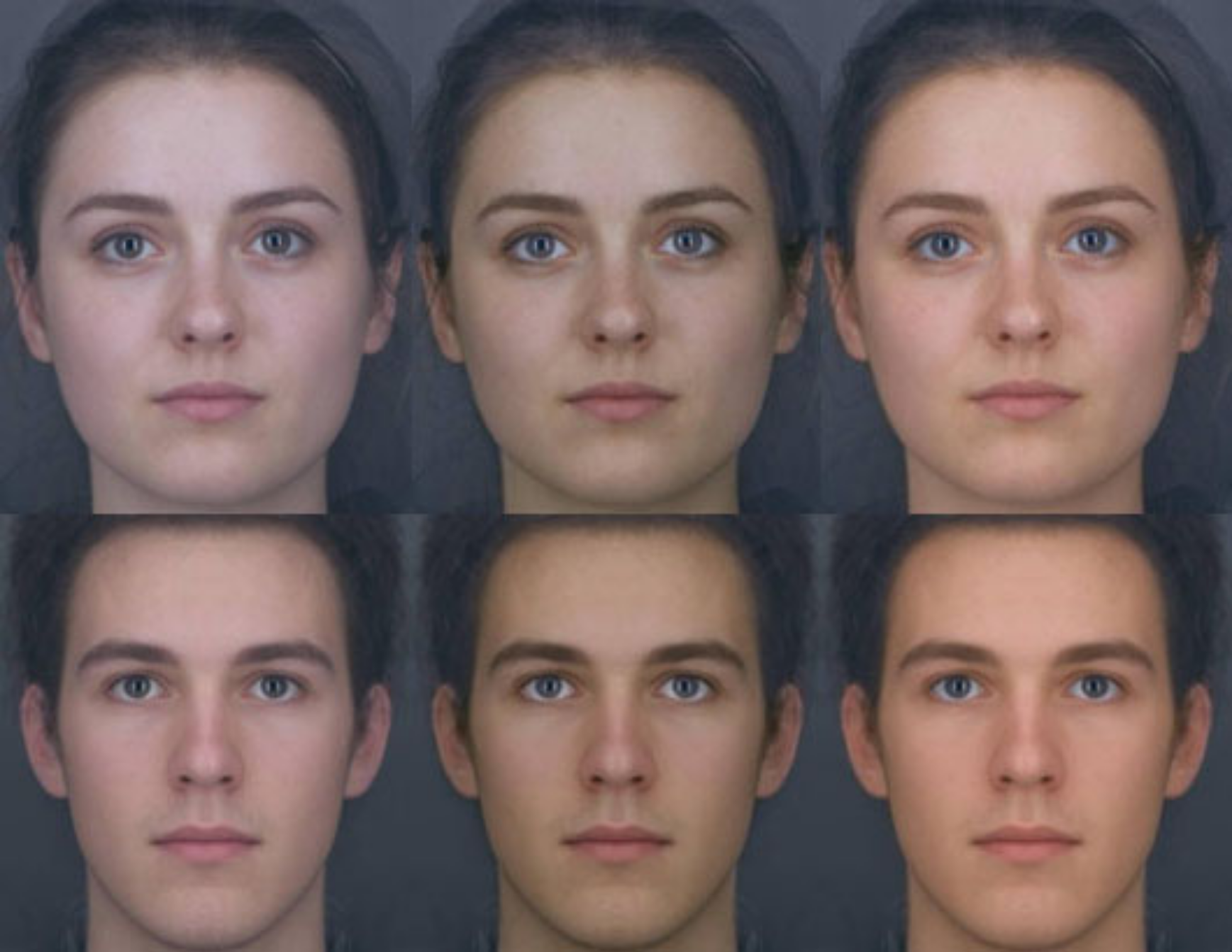
Both white and black participants rated black photographic subjects with higher carotenoid pigmentation as healthier-looking; black South Africans also thought that those with lighter skin looked healthier:

Given the same photographic manipulation task, Malaysian Chinese students also added more yellow tones to optimise the healthy appearance of the photographic subjects (e.g. the photo at right, below), although they rated excessive yellowness as unhealthy-looking, perhaps because it is an indicator of serious diseases like jaundice.

Using an evolutionary toolkit to assess diet advice
To sum up, advocates of animal-based diets that restrict or eliminate plant foods are ignoring a large body of evidence from multiple types of studies which indicate that:
- As a species, we are extremely well-adapted to eating plant foods, meaning that as our lineage co-evolved with the plant kingdom, we developed the capacity to turn so-called anti-nutrients such as phytate and (most) lectins to our benefit;
- Starch-rich plant foods played a pivotal role in our development as large-brained hominids, and without the incorporation of starchy foods into our ancestors’ diet, our particular species (Homo sapiens) would not have emerged; and
- We share with other species, mechanisms for detecting health in our peers which include a highly sensitive ‘radar’ for carotenoid consumption as a marker of immunocompetence and fertility.
The experiences of the COVID era made me highly averse to any form of censorship, so I’m not in favour of the removal of those who advocate extreme animal-based diets from the public discourse. Instead, the responsibility to assess the validity of information lies with you, the reader or viewer. You don’t have to become an expert on paleoanthropology or evolutionary psychology or nutritional biochemistry in order to acquire some basic facts about human beings and their nutritional needs, which will help you to discern reliable sources of guidance from the just-so stories of self-appointed health gurus. If you value your health, it’s well worth your while to invest the time and effort required to do so.
Are you confused by the scientific claims and counter-claims that you encounter through popular and social media? Would you like to learn how to read scientific research, assess its biases, and understand how it fits within the body of scientific literature? My EmpowerEd membership program is custom-made for you. Activate your free 1-month trial today!
- A crisis in which there is no agreed-upon reality. ↩︎




3 replies to "The colour of health"
Now, I think this article is brilliant. Quickly, why didn’t the researchers also actually use diet to improve the appearance of these humans? Since they were pale to begin with? I love me veggies, and I have been told by others’ that I look healthy, my skin, so I don’t doubt it. Still, if you want to convince people, it’s a better way forward.
Now, this moon thing that seems to be swirling up a lot, especially recently… https://www.planetary.org/articles/3172?gad_source=1
They took rock samples, they left instruments that scientists can bounce lasers from, etc. I guess you could say they ‘fabricated’ these 2011 images too, but then why not get them more coverage? They are obscurely waiting for those who do want to do the actual research. Quietly sitting there. I think people draw an emotional connection to certain ideas, almost romanticise about there is such a broad conspiracy, so powerful. ‘What if I told you, you were wrong for all these years’. I even think governments actually sometimes even like this, because it makes the people think ‘if the government can do this, I better stay in my lane’. It also leads to in-fighting of populations, to have this kind of ‘the other side is stupid’.
For example, just as you say “How do you have a conversation with someone who insists that a man can become a woman???”… Well I ask, how can you converse with someone you look down upon? Yet, you are still correct I know.
I notice when I talk to young men these days, they all look and feel so ‘feminine’. From their perspective, if these men have feminine traits from, say, lowering testosterone levels, how can you blame them for looking for answers that satisfy them? Maybe “I was born in the wrong body”, might be the only answer that makes them feel adequate.
Very well written, much truth. I eat tonnes of veggies, I have been told by people that I have a very healthy look to me, that my skin looks healthy… I guess I wish the study used actual diet changes to induce the changes. I understand it adds a variable, but still. It would give additional credibility.
The moon landing thing? I think that needs to go away. https://www.planetary.org/articles/3172?gad_source=1 They’ve brought back soil samples / rocks from the moon. Providing access to those for scientists. They have placed mirrors on the moon that scientists point lasers at to measure distances.
CO2Coalition.org “Bruce Everett formerly worked as an executive for the ExxonMobil Corporation.” Once I see that, I don’t think it’s reputable. Doesn’t this give similar vibes to big pharma shills? Just saying. We know big pharma is a problem, why don’t we think big oil is also a problem? Won’t they be trying to fight this? Are they not both playing the ‘safe and effective’ handbook in their own ways? The other side has it’s own issues of course.
“How do you have a conversation with someone who insists that a man can become a woman???” I know you are correct in what you say. If you start with from a place of judgement, how is that ever going to work? I also know when I speak with young males these days, they mostly lack masculine qualities. Many have high pitch voices, relatively slim looking guys. So many young men seem to fall into this category. We know testosterone levels have plummeted… Do you think they want to look at burly, masculine men, and want to compare themselves to something that they can’t compete with? Where do you expect them to gravitate to? They are going to look for things to make them feel secure, they are looking for their tribe. The power of belonging is such a powerful driver even if sometimes it can be delusional. But you see this more and more on both the left and the right. Neutral perspectives are dead and gone. People don’t even like you if you sit somewhere in the middle.
“I guess I wish the study used actual diet changes to induce the changes” – in one study, which I mentioned in this article, they did: “For example, when Ian Stephens’ team randomised Malaysian Chinese students to receive either a daily carotenoid-rich fruit smoothie or mineral water for six weeks, the smoothie group had a large increase in skin yellowness at four weeks, as measured using a handheld reflectance spectrophotometer.”
Re evidence for the moon landing, once again we encounter the epistemic crisis which is that very few people can personally verify the accuracy of the photos or ascertain that the rock samples genuinely came from the Moon. The retroreflectors are far more persuasive but once again, I lack the detailed knowledge of the field required to verify this and judge its significance.
““Bruce Everett formerly worked as an executive for the ExxonMobil Corporation.” Once I see that, I don’t think it’s reputable. Doesn’t this give similar vibes to big pharma shills?” – actually Big Oil has been pushing the climate change narrative extremely hard, from the get-go. James Corbett’s excellent documentary Why Big Oil Conquered the World explores this in detail: https://corbettreport.com/bigoil/. The father of the modern environmental movement, from which the anthropogenic climate change narrative emerged, was Maurice Strong – a Rockefeller protege who made his money in the oil business.
In any case, whether or not any one individual in the CO2 Coalition formerly worked for the oil industry, I have not seen any scientist in the field contest the data on atmospheric CO2 concentrations presented in the graph that I linked to.
“If you start with from a place of judgement, how is that ever going to work?” I don’t judge people who have been suckered by the ridiculous transgender narrative. But I do despair of being able to have a sensible conversation with anyone who believes that a man can turn into a woman by taking hormones and having surgery. This is so insane that it makes my head hurt. Every cell in your body carries chromosomes – XX if you’re female, XY if you’re male. This is not changed by any medical intervention. If you’re a man who wants to dress up like a woman, OK I guess, but don’t expect me to call you a woman because you ain’t, and you never will be.