If, like me, you grew up watching endless reruns of The Sound of Music1, you will immediately recognise the following lines:
“Let’s start at the very beginning.
A very good place to start.”
So, let’s make like Sister Maria, and start with the basics.
What the heck is DMSO, anyway?
Dimethyl sulphoxide – or sulfoxide, for my American friends – is a colourless, nearly odourless, organosulphur compound with the chemical formula (CH3)2SO, also represented Me2SO. Its origins lie in the marine organosulphur cycle via which algae produce several petagrams (each petagram is 1,000,000,000,000 kg) of dimethylsulphoniopropionate (DMSP) per year; DMSP is then metabolised by algae, bacteria and ozone (O3) into DMSO and numerous other organosulphur compounds:
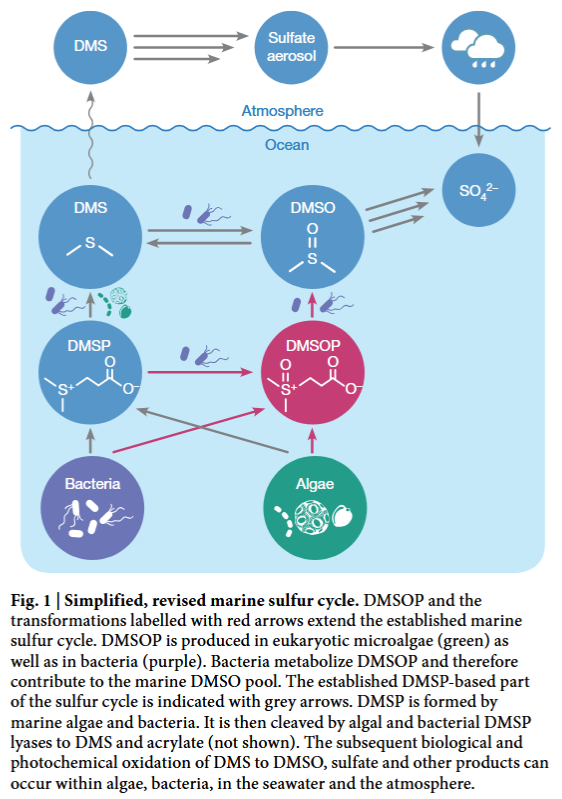
These organosulphur compounds fuel the marine food web by providing key building blocks of amino acids necessary for protein synthesis. And the volatile organosulphur compound dimethylsulphide rises up into the atmosphere, where it affects cloud formation and hence rainfall patterns, and lowers global temperatures by reflecting sunlight.
Rainfall deposits some of this atmospheric sulphur on dry land, where it can be taken up by plants and metabolised into numerous organosulphur compounds. Hence, trace amounts of DMSO naturally occur in a wide range of foods including asparagus, beetroot, cabbage, corn, cucumber, onions, Swiss chard, rhubarb, tomatoes (and especially tomato paste), raspberries, spearmint oil, oats, beer, milk, coffee and tea.
You probably won’t be shocked to learn, however, that the DMSO you can buy in bottles isn’t extracted from raspberries or rhubarb. So where does it come from?
Better living through chemistry
DMSO was first synthesised in 1867 by the Russian chemist, Alexander Zaytsev, who showed that oxidation of dimethyl sulphide with either oxygen or nitrogen dioxide, yields dimethyl sulphoxide. Zaytsev’s discovery remained a curiosity until the development, in the 1880s, of the Kraft process, by which wood is pulped to make paper. The Kraft process produces prodigious amounts of volatile sulphur compounds (including dimethyl sulphide), which accounts for the foul odours emitted by pulp mills.
An important point of clarification: The claim that DMSO is a toxic byproduct of the wood pulping/papermaking industry is misleading. DMSO is indeed a product of this industry’s waste stream, but a) it is not directly produced through the Kraft process (rather, its precursor, dimethyl sulphide, is) and b) it has very low acute toxicity, with an LD50 (the amount of a material, given all at once, which causes the death of 50 per cent of a group of test animals) of 14.5 g/kg body weight. (For comparison, the LD50 of paracetamol/acetaminophen is 338 mg/kg [that’s 0.338 g/kg] in mice and 1944 mg/kg [1.944 g/kg] in rats.) And unlike its smelly precursor, DMSO is virtually odourless and has low volatility, with a boiling point of 189°C.
These days, paper mills are no longer the principal source of DMSO. Instead, hydrogen sulphide (primarily obtained as a byproduct of the coal chemical industry, synthetic ammonia production, oil refinery gas, and natural gas processing) is reacted with methanol over an aluminium oxide catalyst, producing DMSO with higher purity, suitable for applications in the pharmaceutical and electronics industries.
Depending on which narrative you want to spin, you could argue either that DMSO is a naturally-occurring substance produced by some of the most fundamentally important organisms on earth – marine algae – or a synthetic byproduct of two of the industries most reviled for polluting the environment with their toxic byproducts – papermaking and petrochemicals. And you would be correct, either way. Isn’t that wild?
DMSO – what is it good for?
The roll-out of paper mills using the Kraft process, in the late 19th century, resulted in a waste stream from which large quantities of DMSO could be easily produced, prompting further research into its chemical properties. In turn, this led to the discovery of a slew of industrial and, later, medical uses.
First and foremost, DMSO is a powerful solvent – that is, it is able to dissolve a wide variety of compounds, both polar (i.e. with regions of both positive and negative electrical charge) and nonpolar molecules, and both organic and inorganic compounds – including many that are not able to be dissolved in any other solvent. In fact, DMSO is so good at dissolving other substances, it is known as “the universal solvent“. Hence, it found uses in chemical manufacturing and processing, industrial cleaning and degreasing, laboratory chemical reactions, metalworking fluids, manufacture of fibres, resins and polymer materials, production of dyes, pigments and inks, and as a paint remover and antifreeze additive. With the development of the electronics industry, new applications for DMSO were found in the manufacture of optical glass, conductive film and display screens.
Exploration of medical uses for DMSO didn’t get underway until the late 1950s, when two British researchers leveraged DMSO’s antifreeze properties to test its utility as a cryopreservation agent for red blood cells and bull semen. The problem with freezing cells and tissues is that the water they contain forms ice crystals upon freezing, and these ice crystals damage cellular structures so that cells are no longer viable when thawed. DMSO prevents this cellular damage.
In the early 1960s, Dr Stanley Jacob, a surgeon who headed up the organ transplantation program at the University of Oregon Medical School, read the British researchers’ paper and became interested in the possibility that DMSO might be a useful agent for preserving donor kidneys, pending transplantation surgery. Searching for a cheap (or preferably, free) source of DMSO so that he could test his hypothesis, Jacob approached the Crown Zellerbach Company, an Oregon-based paper goods manufacturer which had, quite coincidentally, tasked its staff chemist Robert Herschler with finding commercial applications for the plant’s waste products. Jacobs met with Herschler, obtained some DMSO, and began conducting experiments on it with laboratory animals and subsequently, on himself, his lab assistants, and his patients. Jacobs quickly discovered several actions of DMSO with obvious medical utility:
- It appeared to relieve pain in scalded rats, and when Herchsler applied it to his assistant’s sprained ankle, he reported a prompt reduction in pain and swelling, from which Jacobs inferred anti-inflammatory activity.
- It penetrated the skin and cellular membranes, rapidly entering the circulation when applied topically, and producing ‘garlic breath’ – and a strong taste of garlic – within minutes. (This garlic odour is due to metabolism of DMSO into dimethylsulphide, a volatile metabolite exhaled in the breath.)
- When combined with other drugs, DMSO increased their absorption and effectiveness – as would be expected from a powerful solvent.
- The growth of certain bacteria was inhibited in the presence of DMSO.
- It increased urine production.
- It had muscle relaxant properties.
Word soon spread to The Oregonian newspaper, which ran an article in December 1963 reporting Jacob’s success with treating headaches, arthritis, burns and colds with his new wonder-drug. DMSO’s local media debut was soon followed by a string of laudatory articles published in major national newspapers and magazines, bringing the compound, and Stanley Jacob, into public prominence… and onto a collision course with the Food and Drug Administration (FDA). I’ll cover this controversial chapter of DMSO’s history, and its wide-ranging and long-standing repercussions, in the next part of this series.
Are you confused by the scientific claims and counter-claims that you encounter through popular and social media? Would you like to learn how to read scientific research, assess its biases, and understand how it fits within the body of scientific literature? My EmpowerEd membership program is custom-made for you. Activate your free 1-month trial today!
- My older sister is not ashamed to admit that she knows not only every word to every song, but every spoken word of the entire screenplay of The Sound of Music. Her twin, on the other hand, would rather stick a fork in his own eye than endure five minutes of Julie Andrews and Christopher Plummer randomly breaking into song, rather than just snogging, like regular people. ↩︎