The Trump administration has just released the latest iteration of the Dietary Guidelines for Americans, the 2025-2030 Dietary Guidelines, to rapturous applause from many in the so-called health freedom movement. But even a cursory examination of the Guidelines reveals that they are confusing and contradictory, while a deeper read of the (purportedly) scientific foundation underlying them uncovers significant biases, conflicts of interest and highly selective reporting of the scientific literature on nutrition and health. In short, these new guidelines are a hot mess. Let’s dig in.
Background to the 2025-2030 Dietary Guidelines for Americans
US law requires that the Dietary Guidelines for Americans must be updated every five years. In order to carry out the task of reviewing the scientific and medical literature to produce these updates, the US Departments of Health and Human Services (HHS) and Agriculture (USDA) appoint a Dietary Guidelines Advisory Committee (DGAC), drawn from “nationally recognized experts in the field of nutrition and health”. In January 2023, the Biden administration convened a 20-member DGAC, which, after close to two years of reviewing the literature on nutrition and health (including studies published since the previous guidelines were issued), produced a 420-page scientific report. This report was intended to inform the 2025 update of the Dietary Guidelines for Americans – a policy document that has historically been written by USDA and HHS officials.
However, HHS Secretary, Robert F. Kennedy, Jr and USDA Secretary, Brooke Rollins dismissed this report, citing “ideological bias, institutional conflicts, or predetermined conclusions”. They convened their own committee of nutrition scientists to produce the ‘Scientific Foundation’ report undergirding the 2025 Dietary Guidelines document, which diverged radically from the direction indicated by the discarded report. During their public announcement of the replacement of the previous DGAC and its report, Kennedy explained his rationale as follows:
“Well, we toss out the people who are writing the conflict of interest, and the panel that’s writing it [i.e. the replacement guidelines] will have no conflicts of interest.”
No conflicts of interest. Remember that; we’ll return to that pledge shortly.
The composition of the DGAC – and more specifically, the conflicts of interest of its members – has been a major source of controversy since its inception. The Physicians’ Committee for Responsible Medicine successfully sued the Secretaries of HHS and USDA in 1999 for failing to disclose financial conflicts of interest of committee members, and for violations of transparency and advisory laws; their subsequent lawsuits over undue industry influence on the committee were dismissed by the US District Court. An astonishing 95 per cent of the members of the DGAC for the 2020-2025 update of the Dietary Guidelines had conflicts of interest with the food or pharmaceutical industries which were not disclosed; more than 700 conflicts of interest were identified and over half of committee members had 30 or more connections to various elements of these industries.
Mindful of these ongoing concerns about the financial and ideological entanglements of committee members, and their real, potential and perceived impact on national dietary recommendations, for the first time ever, USDA and HHS released an aggregated list of conflicts of interest of the 20 members of the 2025 DGAC. However, this list did not identify conflicts of individual members, and only covered the year before their appointment to the Committee. In 2023, US Right to Know published a report on the findings of their in-depth investigation into the “conflicts of interest of the members of the 2025 DGAC, including financial and other ties during the last five years to the food, pharmaceutical, grocery, and other industries with a stake in the outcome of the dietary guidelines.”
The report concluded that
“13 of 20 DGAC members had high-risk, medium-risk or possible** conflicts of interest with industry actors.”
‘FULL DISCLOSURE: Assessing Conflicts of Interest of the 2025 Dietary Guidelines Advisory Committee‘, p. 1
Of these 13, 9 committee members were rated as having high-risk or medium-risk conflicts of interest with food, pharmaceutical, and weight loss companies or industry groups, while 4 of 20 had possible relationships with such actors. The remaining 7 of the 20 DGAC members had no conflict of interest in the previous 5 years, representing a significant improvement on the 2020 committee which sported just one unconflicted member.
So, how did the replacement panel convened by Kennedy and Rollins stack up? You know, the one that Kennedy promised would have “no conflicts of interest”? Yeah, about that. Unlike the DGAC that Kennedy dismissed, there’s no evidence that any members of his new committee were vetted under the Federal Advisory Committee Act of 1948 (FACA), which “prohibits advisors with conflicts of interest from serving on federal advisory committees unless they have officially received a waiver declaring their expertise essential and unavailable from other, non-conflicted sources”.
And in fact, 8 out of the 9 authors of the scientific report on which the revised guidelines are based, have conflicts of interest with various appendages of the food industry, including:
- Global Dairy Platform
- National Dairy Council
- American Dairy Science Association
- California Dairy Innovation Center
- California Dairy Research Foundation
- Fonterra Limited (a New Zealand-based multinational dairy co-operative)
- Dairy Management Inc
- Nutricia/Danone (a multinational specialising in baby formula)
- Else Nutrition (another baby formula manufacturer)
- Bobbie Labs (yet another baby formula manufacturer)
- National Cattlemen’s Beef Association
- Texas Beef Council
- National Pork Board
- Seafood Nutrition Partnership
- Unicity (a company that makes dairy- and egg-based meal replacement shakes)
- Adepa (a company that makes gut health supplements)
- General Mills (a US-based multinational that makes breakfast cereals and other highly processed foods)
- Dr Robert C. and Veronica Atkins Foundation (promoters of the low-carbohydrate, animal food-based Atkins Diet)
- Virta Health (a virtual care platform that promotes ketogenic – i.e. high fat, low carbohydrate – diets).
Yeah, no conflicts of interest there, eh, Bobby? All those cosy relationships with the meat and dairy industries obviously have absolutely nothing to do with the fact that their products take pride of place in the infamous inverted food pyramid image that graces the cover of the Dietary Guidelines document:

Not the bloody pyramid again!
Speaking of pyramids, contrary to the bleating of countless terminally online know-nothings about how the pre-Kennedy food pyramid made everyone fat (despite the overwhelming majority of the population not adhering to dietary guidelines anyway), the US hasn’t had a food pyramid since 2011, when the previous version of the food pyramid got the heave-ho, in favour of the MyPlate graphic:

MyPlate lacked specificity (which types of grains should one eat – wholegrains, or white bread, or breakfast cereal?) and was irritatingly inconsistent in its labelling (fruits, vegetables, grains and dairy foods are all actual categories of food whereas protein is a macronutrient that is contained in virtually all foods), but at least it made some intuitive sense. After all, we eat off plates, not pyramids. Especially not upside-down pyramids.
FYI, possibly the best dietary guidelines visual in the world is the Canadian food guide graphic:
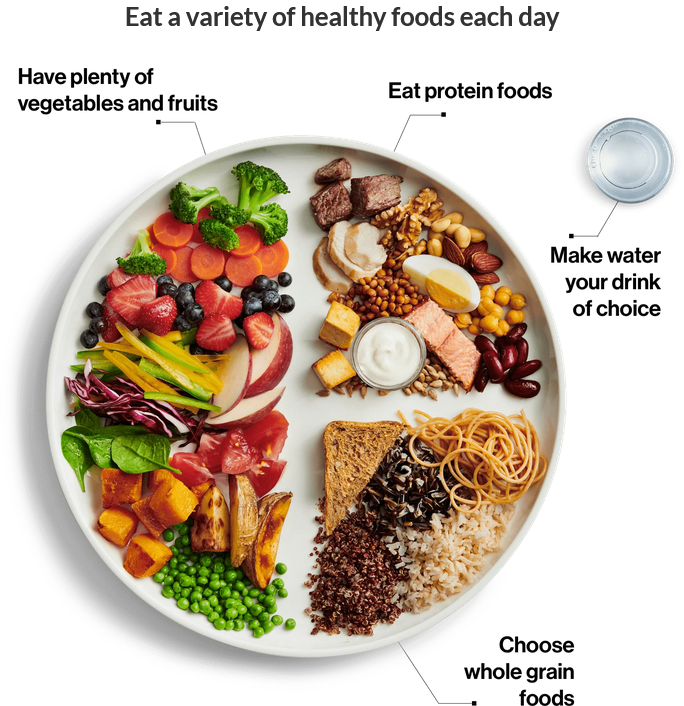
Notably, representatives of the food and beverage industries were excluded from the policy development of Canada’s food guide, which is why what’s on that plate is actually healthy food.
Big fat confusion
For the MAHA groupies who’ve been riding the ‘seed oils are the cause of all disease’ bandwagon (which I dissected in Of Flat Earth and seed oils), one of the biggest surprises in the new Dietary Guidelines For Americans is that it doesn’t mention seed oils at all. In the section titled ‘Include Healthy Fats’, the document advises as follows:
“When cooking with or adding fats to meals, prioritize oils with essential fatty acids, such as olive oil. Other options can include butter or beef tallow.”
Dietary Guidelines for Americans, 2025–2030, p. 3
Yeah, I hate to break it to you, but those cursed seed oils contain abundant amounts of the essential omega-6 fatty acid, linoleic acid, while canola oil also contains a little of the essential omega-3 fatty acid, α-linolenic acid. On the other hand, olive oil, being comprised predominantly of monounsaturated fat, contains very little of either of the two essential fatty acids. And butter and beef tallow, being primarily comprised of saturated fat, contain only small amounts of essential fatty acids, primarily the omega-6 linoleic acid that the anti-seed oil crowd decries. I know that Kennedy and Rollins’ hand-picked team of nutrition experts didn’t write the actual guidelines (as usual, it was HHS and USDA staffers that performed this function), but either way, how did this glaring error, which a first-year nutrition student could identify, make it through the editing process?
The next paragraph in the ‘Include Healthy Fats’ section reads as follows:
“In general, saturated fat consumption should not exceed 10% of total daily calories. Significantly limiting highly processed foods will help meet this goal. More high-quality research is needed to determine which types of dietary fats best support long-term health.”
Um, hang on a minute. According to MAHA ideology, aren’t those “highly processed foods” bad for health largely because they’re high in ‘seed oils’, which are unsaturated fats? The Scientific Foundation document explicitly states that “seed oils account for approximately 70% of added fats to foods, thus being the main source of lipids used in normal cooking (e.g. at home), restaurants (e.g. frying), and industrial making of ultra-processed foods”. Limiting consumption of “highly processed foods” will have bugger-all effect on one’s ability to meet the goal of limiting saturated fat intake.
And how does recommending beef tallow, which is roughly 50 percent saturated fat, conform to the recommendation to limit saturated fat consumption to less than 10 per cent of daily calories? Just two tablespoons of beef tallow contains 12.8 g of saturated fat. In a 2000 calorie per day diet, this would yield almost 6 per cent of daily calories as saturated fat.
It gets even more nuts when you peruse the Daily Servings By Calorie Level document, which gives specific guidance on the number and size of servings of each food group:
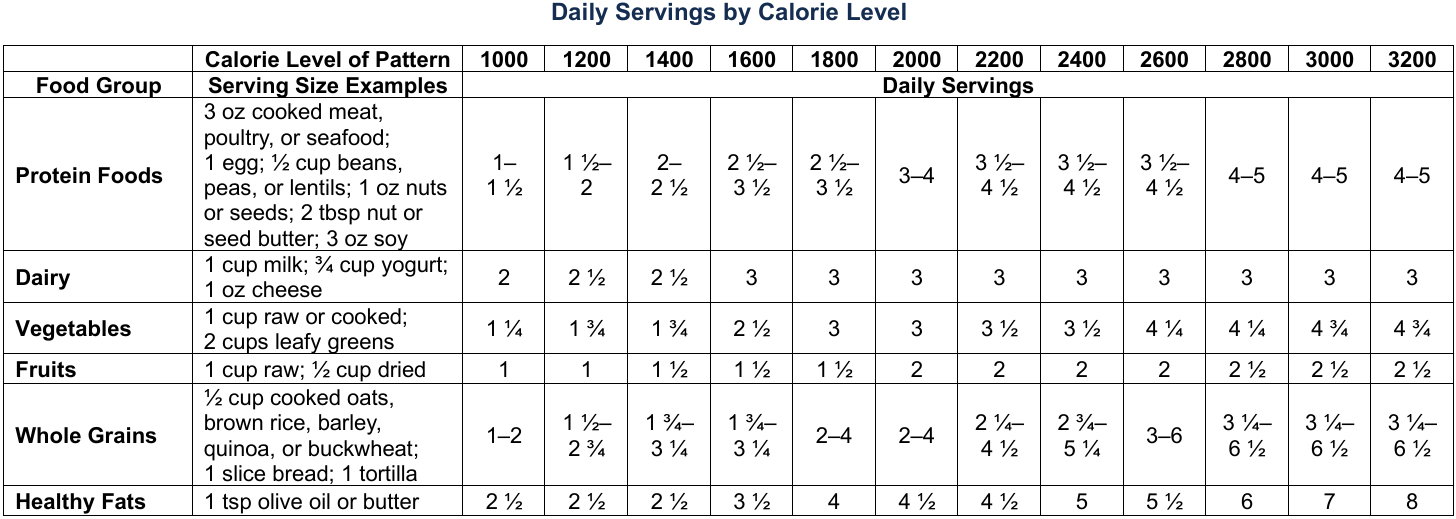
So let’s crunch some numbers for a hypothetical 70 individual who eats 2000 calories per day, using the exact same specified serving sizes as the Daily Servings document, and also aiming for the 1.2-1.6 g of protein per kg of body weight per day recommended in the Dietary Guidelines document (i.e. 84-112 g protein). I deliberately selected lower fat flesh options and split the ‘Healthy Fats’ recommendations between butter and olive oil, in order to give these recommendations the fairest shake possible, and I used CalorieKing for the nutrition data.
| Food | Quantity | Protein (g) | Saturated fat (g) |
| Sirloin steak (lean only), grilled/broiled | 3 oz | 26 | 1.9 |
| Atlantic salmon, grilled | 3 oz | 18.8 | 2.1 |
| Egg, boiled | 1.8 oz (large) | 6.3 | 1.6 |
| Milk, whole | 1 cup (8 fl. oz) | 7.9 | 4.6 |
| Yogurt, from whole milk | 3/4 cup | 6.9 | 4.2 |
| Cheese, cheddar | 1 oz | 7.1 | 6 |
| Butter | 2.5 tsp | 0 | 5.7 |
| Olive oil | 2 tsp | 0 | 1.3 |
| Totals | 73 g | 27.4 g |
So with three serves of the healthiest types of animal flesh ‘protein foods’, three serves of whole milk dairy products, and 4-1/2 serves of ‘healthy fats’ as recommended by the Daily Servings guidelines, our hypothetical individual has racked up 27.4 g of saturated fat, which yields 247 calories, which is 12.3 per cent of daily calories – already exceeding the 10 per cent maximum stipulated in the guidelines. Using that 2 tablespoons of tallow as a cooking fat jacks this up to 40.2 g of saturated fat, which works out as 18 per cent of daily calories – close to double the recommended maximum. And so far, our 70 kg individual is still 11 g short of they/them’s minimal protein target of 84 g per day.
You simply cannot conform to the overall guidelines if you follow the serving size recommendations. The fact that nobody who worked on these documents actually bothered to sit down and run some basic calculations, speaks volumes about how rushed and sloppy the process was – in stark contrast to the thorough and methodical approach taken by the sacked DGAC.
Are nutrition RCTs really the ‘gold standard’?
The statement “More high-quality research is needed to determine which types of dietary fats best support long-term health” demands further exploration. The authors of the Scientific Report devote considerable column space to arguing that evidence gathered from observational trials should not form the basis of dietary guidelines, since “observational cohort studies can reveal patterns but cannot prove causation, no matter how large”. Instead, they insist that more randomised controlled trials are required, because “high-quality RCTs can provide the most reliable evidence of true cause and effect relationships between nutrients and disease”. (How ironic then, that one of the leading American scientists conducting nutrition RCTs, Dr Kevin Hall, claims that censorship of his work by Kennedy’s aides forced him into early retirement.)
Obviously, people cannot be randomised to eat a particular dietary pattern for years, let alone for their whole lives. And RCTs are insanely expensive to run, which means they’re limited to small sample sizes. Given these self-evident limitations, nutrition researchers place heavy reliance on large cohort studies, which track the dietary habits of thousands of people over years (even decades) and correlate these habits with health outcomes. So, how different are the outcomes of RCTs that test nutritional interventions, from cohort studies in which participants self-select their diets? According to a meta-epidemiological study evaluating agreement between bodies of evidence from randomised controlled trials and cohort studies in nutrition research, the difference in outcomes is quite small. That is, when factors such as participant characteristics, and ranges of consumption of various food items, are similar between RCTs and epidemiological studies, the results are generally quite comparable. In simple terms, once we have enough evidence from large cohort studies, we can start to infer causation.
And the epidemiological evidence that reducing saturated fat intake and replacing it with either unsaturated fats from plants or seafood, or carbohydrates from whole grains, reduces the risk of coronary heart disease, heart failure and stroke, is overwhelming, especially for people at high risk of a cardiovascular event.
So too is the evidence that substitution of plant protein-rich foods for animal protein-rich foods reduces the risk of cardiovascular disease, type 2 diabetes and all-cause mortality.
Frankly, if Kennedy’s crack team of meat- and dairy-funded ‘experts’ want to claim that animal-derived foods are beneficial for health, and should be emphasised in the diet to ease the burden of chronic disease, the onus of proof is on them.
Ultraprocessed foods – the picture is more complicated than it seems
The Scientific Foundation document devotes a lengthy chapter to discussing the contribution of highly processed or ultraprocessed foods to poor health outcomes. Their evidence review concluded that high ultraprocessed food consumption is linked to increased risk of type 2 diabetes, dementia, all-cause mortality, cancer, cardiovascular disease and obesity, with a dose-response relationship evident (the more ultraprocessed food you eat, the worse your health outcomes). And by the way, all the studies they cited were cohort studies. So it’s totally fine to use epidemiological data when it suits your narrative, apparently.
However, Kennedy’s crack team of nutrition experts failed to discuss the emerging literature that points to differences in health outcomes between different types of ultraprocessed food. For example:
- In a study of 266,666 participants followed up for around 11 years, consumption of animal-based ultraprocessed foods, and of artificially and sugar-sweetened beverages, was associated with an increased risk of cancer, diabetes and heart disease, while ultraprocessed breads and cereals, and plant-based alternatives, were not associated with increased risk.
- In the Harvard cohort studies, enrolling a total of 206,957 US female nurses and male health professionals whose diets are assessed every 2-4 years, higher cardiovascular disease risk was seen in those who consumed more sugar-/artificially-sweetened drinks and processed meats, while consumption of bread/cold cereals, yoghurt/dairy desserts, and savoury snacks was associated with lower risk:

Figure 2: Association between group-specific UPF intake (highest vs. lowest quintile) and cardiovascular disease in three US cohorts. From ‘Ultra-processed foods and cardiovascular disease: analysis of three large US prospective cohorts and a systematic review and meta-analysis of prospective cohort studies‘.
- Then there’s the Harvard cohort study of ultraprocessed food intake and mortality risk, which found that while higher total consumption of ultraprocessed food was linked to increased mortality, ready-to-eat meat/poultry/seafood based products and sugar-sweetened beverages had the strongest association with premature death.
- And in the European Prospective Investigation of Cancer (EPIC) cohort study of 311,892 individuals followed up for an average of 10.9 years, consumption of plant-based meat and milk alternatives was associated with less than half the risk of developing type 2 diabetes, while animal-based ultraprocessed foods more than doubled the risk:

- And finally, a systematic review and meta-analysis of studies examining the association between ultraprocessed food intake and all-cause mortality concluded that high total consumption of ultraprocessed foods, sugar-sweetened beverages, artificially sweetened beverages and processed meat/red meat were all significantly associated with increased risk of mortality, but “breakfast cereals were associated with a lower mortality risk”.
Isn’t it weird that, in a chapter on ultraprocessed foods with 39 references, that purported to be a thorough survey of the evidence base, four of these studies were not mentioned at all while the fifth was included in the references section, but not actually cited in the chapter? Yeah, it’s weird.
Summing up
There are a few redeeming features of the 2025 Dietary Guidelines for Americans created by Kennedy and Rollins’ hand-picked team of dairy and meat industry-funded ‘nutrition experts’. The emphasis on whole grains instead of refined carbohydrates, avoidance of sugar-sweetened and artificially-sweetened beverages, and limiting intake of food additives, are all welcome. The advice to eat fruits and vegetables throughout the day is also sound, but the recommended number of servings – just two pieces of fruit and three serves of vegetables for a 2000 calorie per day diet – is wildly inadequate. Doubling these servings would bring the Dietary Guidelines into line with research showing that seven or more portions of fruits and vegetables per day is associated with the lowest mortality risk while 7-8 portions per day is associated with enhanced psychological well-being.
But the inconsistencies, cherry-picking of data and selective reporting of key studies on dietary fat, animal products and ultraprocessed food render these guidelines fatally flawed. Follow them at your own peril.